ESR integration

Stop wrestling ESR files. Query for what you need.

WeHub takes the ESR files as they land, parses them, and lets you run SQL to pull exactly the data you need. Validation, cross-Trust matching and a reconciliation report happen in the same pass.

For NHS workforce, HR, digital and ICS teams who need ESR data somewhere else.

Certified, UK-hosted, and isolated per customer

Cyber Essentials PlusWhole-organisation scopeIASMEAssure TechnicalUK data residency (UK South)Per-customer tenant isolation

The problem

Processing ESR files is hand work, and it costs capacity and data

ESR delivers extracts, not answers: delta .DAT files shaped for a machine, not for the system that has to read them. Every destination needs a different subset in a different format, so someone builds and maintains a separate route to each one by hand.

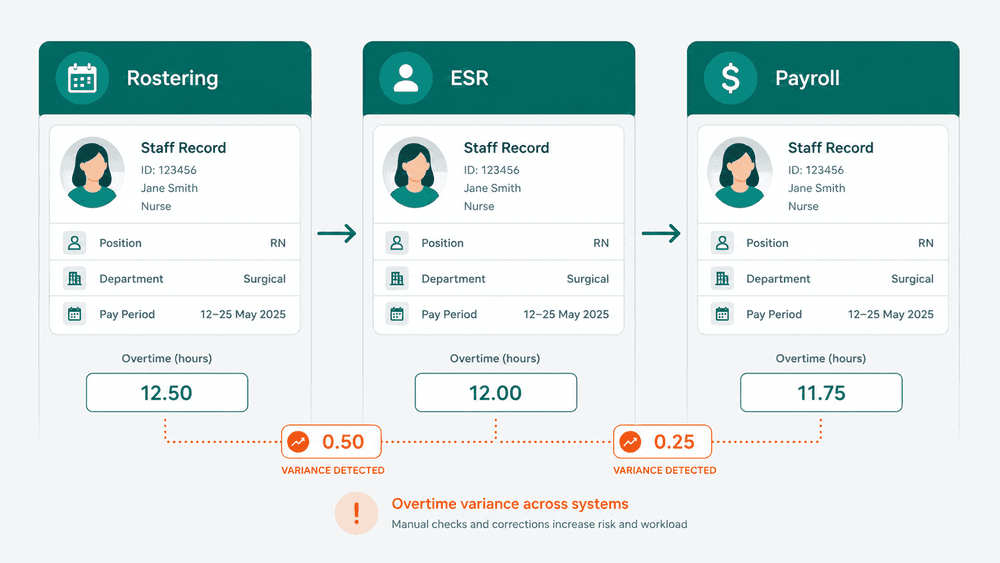
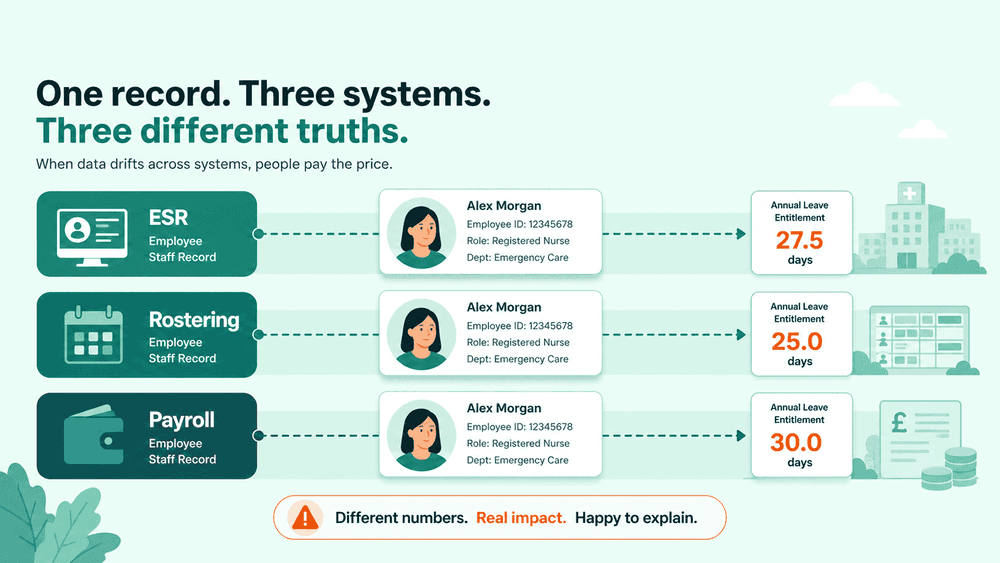
Then something changes. A new field, a vendor upgrade, another Trust, and every route has to be reworked. Records that do not fit are dropped in silence: a duplicated person, a manager in another Trust, an organisation reference the receiving system has never seen. Nothing tells you what went missing.

ESRRosteringData WarehouseHR SystemsBIPayrollLocal scriptsSpreadsheetsDelta .DAT filesPer-Trust VPD

Solution

WeHub sits between ESR and everything downstream

ESR exports arrive once. WeHub parses them, validates them, and delivers exactly the data each system needs, with execution history and failure drill-down behind every run.

SourceESR
  • Data Warehouse

  • Rostering

  • BI Dashboards

The same flow serves every team that needs the workforce record somewhere other than ESR.

Workforce and HR leads

E-rostering and bank staffing leads

Digital and integration teams

ICS workforce leads

What we do

What WeHub does with an ESR file

For the technical reader: the four things that happen between the file landing and the data being usable.

01

Read the drop

Files land on the channel you agreed. WeHub lists what arrived, works out which files belong to this run, and records when they came and from where.

02

Parse files

The ESR file structure is read directly by a native parser, not by a bespoke script that has to be rewritten every time a format changes.

03

Query your ESR

Once parsed, the data is queryable. You pull exactly the records each destination needs instead of shipping everything and filtering it downstream.

04

Get your output

Mapped, validated, and delivered as CSV over SFTP, in the shape the receiving system takes. Anything that could not be placed comes out categorised with a reason.

ESR integration questions

No. WeHub consumes the extracts ESR produces. Files arrive each morning on an agreed channel, sent either by NHSBSA or by the Trust, and WeHub takes over from there.
WeHub has a native ESR parser, so the file structure is read directly rather than through a bespoke script. Which specific extracts are in scope is agreed during the mapping session.
Records are matched across Trust VPDs and duplicates are resolved against a primary record. Anything that cannot be resolved automatically comes out on the reconciliation report rather than being merged or dropped.
WeHub does not persist your ESR data. Files are processed in flight and passed to the destination system, not stored as a copy. Processing runs in UK South with per-customer tenant isolation, and if your requirement is that data never leaves your estate, WeHub Runner lets you design in the WeHub panel and execute inside your own environment.
It comes out on the reconciliation report with a category and a reason, and it does not reach the destination system. Manager link not found, cross-Trust duplicate, missing position, missing organisation, invalid email: each one is named rather than silently dropped.

Ready when you are

Ready to stop ESR being the bottleneck?