
Leave entitlement is one of those topics that looks settled until you actually look at it. The policy is in the Agenda for Change handbook. ESR has accrual plans, override elements, bank holiday toggles. Trusts have ready reckoners on the intranet. On paper, this is a solved problem.
In practice, it's one of the quietest sources of payroll error, BI noise, and IG headache in any Trust - and the reason almost always sits at the integration layer, not the HR one. The healthcare integration mistakes that break leave entitlement are the same ones that break ADT feeds, ESR onboarding, and Spine reconciliation. Leave just makes them visible faster, because every employee notices.
This piece is for the IT Lead, integration architect, or Head of Digital who keeps getting pulled into "why does ESR say something different to roster" conversations and wants the real answer.
The meeting that keeps happening
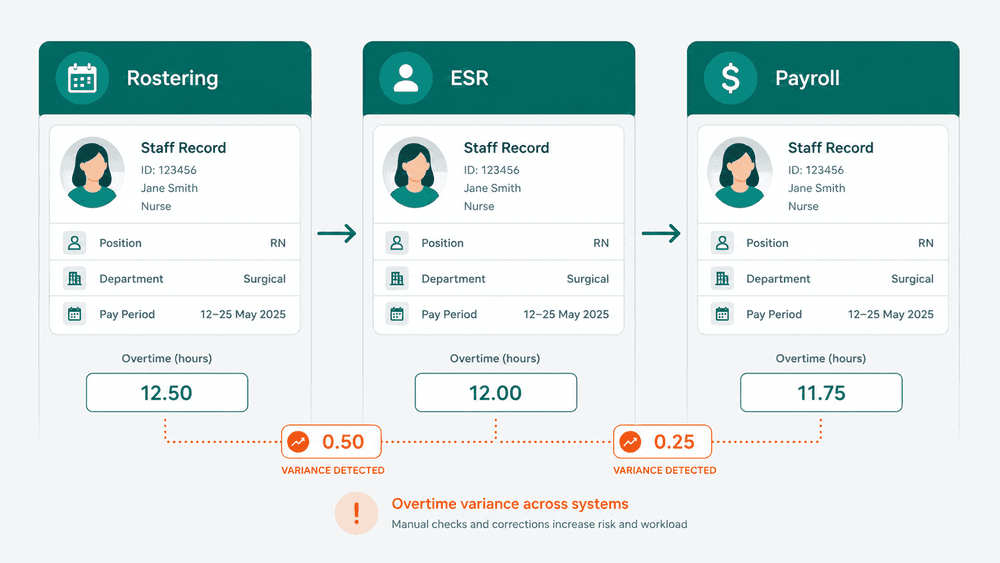
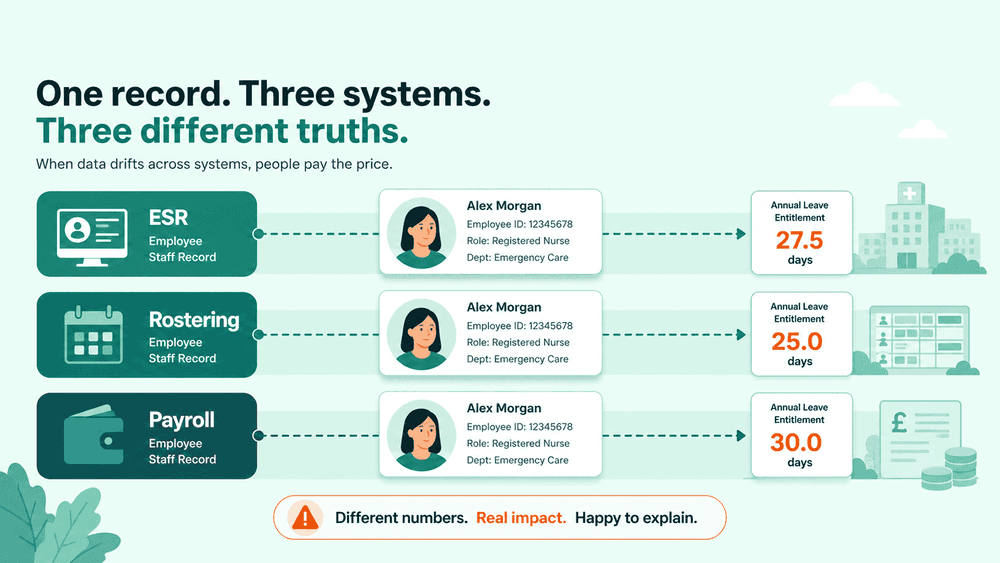
You know this meeting. Workforce, Payroll, Rostering, and someone from IT in a room because a clinician's annual leave balance in ESR doesn't match what their roster shows, and payroll has already paid out the wrong figure. Workforce says ESR is correct. Rostering says the file came through fine. Payroll says they processed what they received. IT is asked to "look at the integration."
By the time anyone has untangled it, three things are usually true. The accrual plan in ESR was overridden mid-year and nobody told the rostering team. The monthly absence file from the rostering system loaded with a date offset that nobody noticed because the totals roughly matched. And the BI dashboard that flagged the variance is pulling from a snapshot that's three days old.
None of those are HR errors. They're integration errors. And they keep happening because the integration was designed for the happy path - not for the way leave entitlement actually behaves in a Trust.
ESR isn't the system of truth everyone assumes it is
The first healthcare integration mistake is treating ESR as a single source of truth for leave. It isn't, and the official guidance is honest about why.
ESR holds the entitlement calculation - accrual plans, FTE-based hours, bank holiday inclusion, the override elements that adjust an individual's allocation when service history or buy/sell adjustments come in. But the actual booking, approval, and consumption of leave often lives somewhere else entirely. Many Trusts run absence through Healthroster or another rostering system and feed a monthly file back into ESR for payroll and monitoring. Some run leave directly in ESR Self Service. Some do both, depending on staff group.
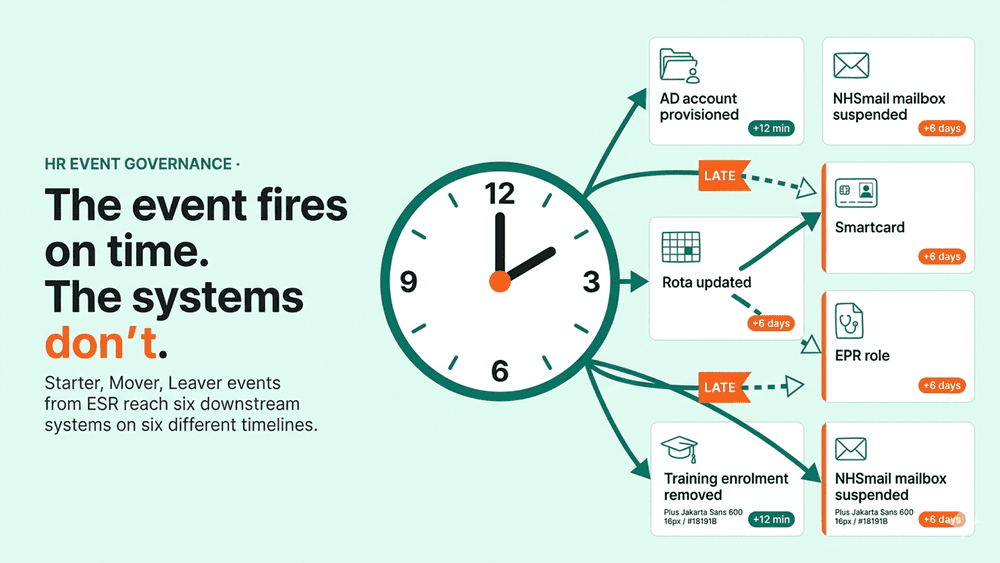
So when an architect asks "where does leave entitlement live?", the honest answer is: it's distributed across at least three systems, with a lag, and the rules for which system wins depend on the staff group and the local policy. That's the reality any integration has to be designed for. Pretending ESR is canonical is how you end up with the meeting above.
Where leave entitlement actually breaks
The break points are predictable once you know where to look:
- The override layer. ESR's Annual Leave Hours Override element will keep showing the full override amount even after an employee is terminated mid-year, unless someone manually clears it. Any integration that reads entitlement without checking termination status will quietly produce wrong numbers for leavers.
- Service milestones. Entitlement changes at five and ten years of aggregate NHS service. If your integration caches entitlement values rather than recalculating from current ESR state, every milestone crossing produces drift.
- Bank holiday inclusion. Since the 2024 change at many Trusts, bank holidays are now included in the displayed entitlement. Any downstream system that adds bank holidays again - or strips them out - is double-counting or under-counting depending on the era of the integration.
- Bank staff accruals. Bank annual leave is calculated as a percentage of YTD hours worked. The percentage is configurable per organisation. If your integration assumes 12.07% nationally and the Trust uses a local GRR, the entitlement you publish is wrong from day one.
- Inter-Authority Transfers. Reckonable service from previous NHS employment flows in via IAT. If the IAT hasn't completed when your integration reads entitlement for a new joiner, you've published a number that's about to change.
- The monthly file. The absence feed from Healthroster, or equivalent, into ESR is one of the highest-volume, lowest-monitored healthcare integrations in any Trust. When it fails partially - a few rows reject, the rest load - nobody notices until payroll runs.
Each of these is a leave problem and an integration problem at the same time. That's the part Trust IT teams often miss.
Six healthcare integration mistakes that show up in leave data
These aren't unique to ESR or to leave. They're the mistakes that show up across HL7 feeds, FHIR transforms, ADT messaging, and Spine integration too. Leave just exposes them clearly because the business impact is immediate and personal.
1. Treating one system as canonical when the truth is distributed. Leave entitlement is computed in ESR, consumed in rostering, settled in payroll, and reported in BI. Designing as if ESR alone is canonical means every other system silently disagrees with it.
2. Caching values instead of recomputing. Entitlement is a function of FTE, service length, bank holiday flag, and override elements - all of which change. Storing yesterday's number and treating it as today's is the most common single cause of leave drift.
3. No reconciliation layer. Most Trust integrations are one-way pipes. There's no scheduled job that compares ESR entitlement against rostering balance against payroll output and flags variance before payroll runs. When the variance only surfaces in the payslip, you've already lost.
4. Date logic that ignores the leave year boundary. The NHS leave year runs 1 April to 31 March. Override elements have effective dates that interact with this. Integrations that batch on calendar months without respecting the leave year boundary produce off-by-one errors that compound across the year.
5. Silent partial failures. A monthly absence file with 4,800 rows that loads 4,790 rows and rejects 10 will look healthy in most monitoring. The 10 rows are the ones IT will hear about, six weeks later, in a payroll dispute. Healthcare integrations need row-level reconciliation, not just job-level.
6. No audit trail at the field level. When entitlement changes, the question that always gets asked is "why is it different now?" If your integration does not log what came in, what was transformed, and what was written, you cannot answer that question. The DSPT alignment alone makes this non-negotiable, but most ESR integrations log at the job level only.
What good looks like - the integration pattern that holds up
The Trusts that have stopped having the meeting at the top of this article tend to share four things in their integration design.
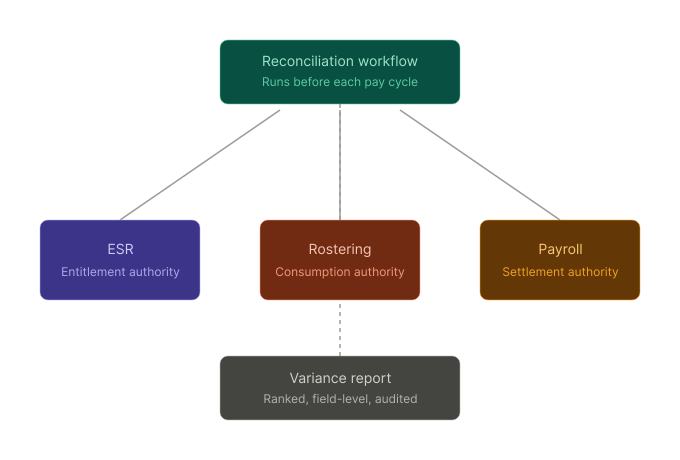
They treat ESR as theauthority for entitlement calculation and rostering as the authority for consumption, and they document that explicitly. The integration doesn't try to reconcile the two by overwriting - it surfaces variance for a human to resolve.
They run a scheduled reconciliation workflow between ESR, rostering, and payroll before each pay run. It doesn't fix anything automatically. It produces a list of the employees whose entitlement, balance, and payroll figures don't agree, ranked by variance, in time for someone to investigate.
They log every transformation at the field level. When an override element flows in, when an FTE change recalculates, when an IAT settles - those events are captured with before-and-after values. This is the audit trail that makes IG and DSPT conversations short instead of painful.
They build the integration as modular workflows, not a single monolithic file transfer. Reading from ESR, transforming to a normalised model, validating, writing to rostering, monitoring, and reconciling are separate steps. When one breaks, the others keep running and the failure is visible.
This is the pattern WeHub's workflow designer was built for, but the pattern matters more than the tool. Any Trust running a serious ESR integration should be able to point to all four of these properties in their architecture.
The bottom line
Leave entitlement isn't the most strategic dataset in your Trust. It's just the one that exposes integration weakness most reliably, because every employee checks their own balance and notices when it's wrong.
If the meeting at the top of this article happens in your Trust more than once a quarter, the fix isn't more HR training. It's a reconciliation workflow between ESR, rostering, and payroll that runs before each pay cycle and surfaces variance before it becomes a payslip dispute.
Start there. The same pattern, once it's in place for leave, is the one you'll reuse for every other healthcare integration where ESR sits at one end and a clinical or operational system sits at the other.