
Sign in
Back to blogs
The preview of Top 5 Healthcare Workflow Automation Tools for NHS Hospitals in 2026 post
Workflow Automation in Healthcare

Top 5 Healthcare Workflow Automation Tools for NHS Hospitals in 2026

Search "healthcare workflow automation tools" and most results are written for US ambulatory clinics. This is the version pitched at NHS IT Leads: five platforms that actually appear in Trust digital stacks, what they do well, and where they hit their limits.
Medi Harsini
Medi Harsini
Reading time: ~7 min
Written for the NHS IT Lead, Digital PM, or CTO doing TOFU market scanning on workflow automation, who is tired of opening lists optimised for US ambulatory care. The piece stays informational and avoids product-led framing: WeHub appears as the fifth entry with the same word count and tone as the other four, and the closing reduces the next step to a mapping exercise rather than a demo booking. The three-layer synthesis is the real takeaway, designed to reframe how the reader thinks about their existing stack rather than push toward a single procurement.

Search "healthcare workflow automation tools" and you get two flavours of unhelpful. The first half of the results are US ambulatory-clinic explainers: Athenahealth, Epic-adjacent CRMs, scheduling platforms aimed at a twelve-provider practice in Texas. Useful if you run one of those. Useless if you run integration inside an NHS Trust. The second half are generic iPaaS comparisons (Zapier, Make, n8n) written without any awareness of HL7v2, ESR, or NHS Spine.

Neither version helps the person who actually has to pick a workflow platform for an NHS hospital. This piece is for them.

The five healthcare workflow automation tools below are the ones that consistently show up in real NHS digital stacks in 2026, picked across three categories: integration engines (the workhorses that route messages between clinical systems), low-code workflow (the layer most Trusts now run on top of M365), and NHS-native automation (platforms built around the specific systems Trusts have to live with). Same length, same tone, for each. WeHub is on the list and we've written about it with the same restraint as the other four.

Why this list looks different to the American ones

Workflow automation in a US hospital usually means scheduling, patient intake, billing follow-up, and revenue cycle management. Workflow automation in an NHS hospital means something quite different. It means routing HL7v2 messages from a PAS to a LIMS without losing patient identifiers. It means feeding ESR changes into rostering and payroll without drift. It means turning a Spine PDS trace into a populated record in three downstream systems. It means closing a Datix incident with the right notifications firing into the right inboxes.

The tools that handle those jobs are not the same tools that win G2 reviews for US clinics. The list below is filtered for what an NHS IT Lead, Digital PM, or CTO is actually going to evaluate.

1

InterSystems IRIS for Health

InterSystems IRIS for Health is the integration engine sitting under a meaningful share of NHS Trust integration estates, usually because it arrived alongside another InterSystems product (TrakCare, HealthShare) or replaced an older Ensemble deployment. It handles HL7v2, FHIR, X12, and custom messaging, with a developer experience built around ObjectScript and a production-grade runtime that holds up at Trust scale.
What it's good at: heavy-duty message routing with deep transformation logic, particularly when the team has InterSystems skills already. The ecosystem around it (HealthShare, IRIS Data Platform) means the integration estate and the analytics estate can share infrastructure if you want them to.
Where it hits limits: ObjectScript is a small talent pool in the UK, and developer recruitment slows projects more than the licence cost does. The interface designer is powerful but not friendly to citizen developers, so anything beyond the engine itself usually needs a dedicated integration team.
INTEGRATION ENGINEHL7V2 - FHIRHL7v2FHIRX12ObjectScriptOn-prem or cloudTrust-scale clinical messaging
2

Rhapsody

Rhapsody is the other integration engine NHS Trusts reach for, often the incumbent in Trusts that built their integration practice in the 2010s. Originally part of Orion Health, now a standalone company (Rhapsody Health Solutions) following the Corepoint, NextGate, and Datica acquisitions. It runs on a clear visual routing model, supports the full HL7v2, FHIR, X12, and DICOM stack, and has a deployment footprint across NHS England, Scotland, and Wales that means there is usually someone nearby who has solved the problem you are looking at.
What it's good at: visual route design that integration engineers can pick up quickly, mature support for HL7v2 (which still carries most NHS clinical traffic), and a Corepoint line for organisations that want a lighter footprint. The community knowledge base is one of its real assets.
Where it hits limits: like IRIS, it is an engine, not a workflow orchestrator. Anything past message routing (long-running approvals, human-in-the-loop steps, M365 integration, dashboarding) usually needs a second tool. Trusts that try to make Rhapsody do everything end up with custom code holding the seams together.
INTEGRATION ENGINEHL7V2 WORKHORSEHL7v2FHIRX12DICOMOn-prem or RaaSVisual route design
3

Microsoft Power Automate

Power Automate is the most-deployed workflow automation tool in the NHS by user count, almost by default. Every Trust on NHSmail and M365 has it available, and Digital teams discover it the first time they need to automate a form, a notification, or a SharePoint approval. For low-stakes process automation around the M365 estate, it is genuinely the right answer.
What it's good at: form-driven approvals, email and Teams notifications, document workflows, simple data movement between M365 surfaces and a handful of connectors. The licence is already paid for in most Trusts, which means it gets adopted faster than anything that needs procurement.
Where it hits limits: Power Automate is not an integration platform for clinical data. The HL7 and FHIR connector story is thin, error handling is shallow, and DSPT-grade audit trails on Power Automate flows require careful design that most teams do not do up front. Trusts that try to push clinical workflows onto Power Automate run into reliability and audit problems within twelve months.
LOW-CODE WORKFLOWM365-NATIVEM365SaaSForm approvalsTeams automationSharePoint workflowsLow-code
4

ServiceNow

ServiceNow shows up in larger NHS Trusts as the enterprise workflow platform, usually procured for IT service management first and then extended into HR, clinical engineering, and incident workflows. It is a credible workflow engine with strong case management, SLA tracking, and a mature integration hub.
What it's good at: structured, ticket-shaped work where SLAs and audit trails matter (IT incidents, clinical engineering, estates, IG requests). The Now Platform handles long-running, multi-stakeholder workflows well, and Integration Hub extends it into the wider system estate.
Where it hits limits: the licensing model is built for enterprise spend, and most NHS Trusts cannot justify the per-user costs once you push beyond IT. Clinical and operational workflows that need direct HL7 or FHIR integration usually require a separate engine in front of ServiceNow, which means you are paying for two layers to do one job.
Enterprise workflowITSM-firstSaaSPer-user licensingSLA and case managementITestatesclinical engineeringIG
5

WeHub

WeHub is an NHS-native iPaaS and workflow automation platform, built specifically around the integration surface NHS Trusts actually work with: ESR, NHS Spine, PDS, e-RS, EPS, HL7v2, and FHIR R4. The product sits in the same conceptual space as the integration engines above but is designed around modular workflows rather than message routing, with a low-code surface that Digital teams can operate without a dedicated integration developer team.
What it's good at: ESR-adjacent workflows (onboarding, leavers, leave reconciliation, rostering feeds), Spine and PDS-driven processes, and the long tail of Trust-specific workflows that traditionally fall between the integration engine and Power Automate. DSPT-aligned audit trails are built in at the field level, not bolted on afterwards.
Where it hits limits: WeHub is not trying to replace a Rhapsody or IRIS deployment that already handles high-volume HL7v2 routing at scale. It is the layer above, where workflow logic lives. Trusts treating it as a like-for-like engine swap are usually solving the wrong problem.
Full disclosure: this is our platform. We have written the entry with the same restraint as the other four because the list is more useful that way.
NHS-NATIVE IPAASWORKFLOW LAYERESRNHS SpinePDSe-RSEPSHL7v2FHIR R4DSPT-aligned audit trail

How these healthcare workflow automation tools fit together

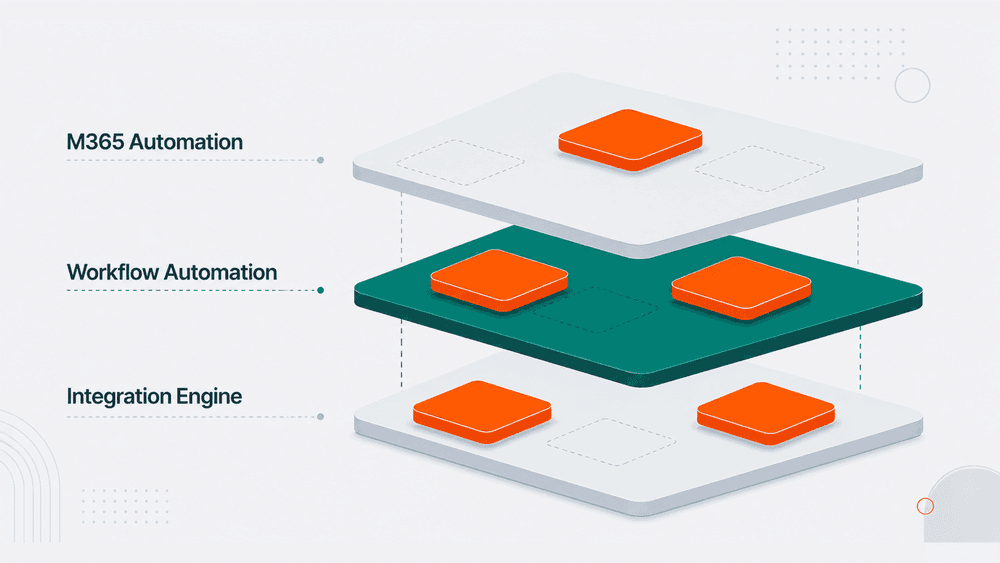
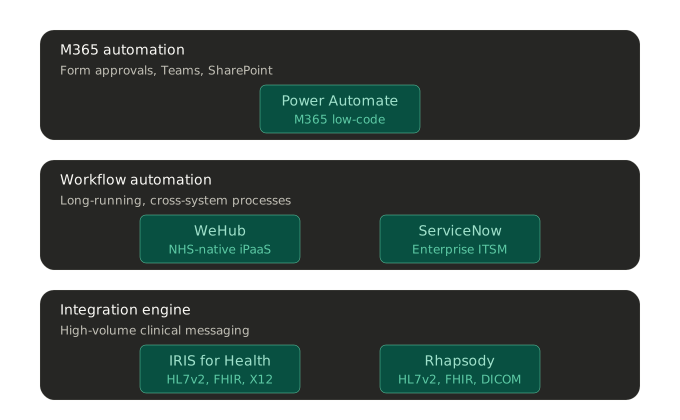
Look across the five and a structure emerges. NHS Trusts that have their workflow estate under control tend to run a layered stack, not a single platform. An integration engine (IRIS or Rhapsody) handles high-volume clinical messaging. A workflow automation layer (WeHub, or a heavier ServiceNow build) handles the longer-running, multi-system processes the engine is not built for. Power Automate handles the M365-side automation that does not need clinical integration.

Three-layer NHS workflow automation stack: integration engine, workflow automation, and M365 automation

Trusts that struggle are almost always trying to make one tool do all three jobs. The engine team builds workflows that should have been low-code. The Power Automate team builds clinical integrations that should have been on the engine. The result is a brittle estate where ownership is unclear and every change is risky.

The interesting question is not which of these five healthcare workflow automation tools is best. It is where each one fits in your stack, and which jobs you are currently asking the wrong tool to do.
Where to start

If you are scanning this list because you are between procurement decisions, the most useful exercise is not a feature comparison. It is mapping your current workflow estate against the three layers above (integration engine, workflow automation, M365 automation) and listing which workflows are running in the wrong layer. That single exercise tends to surface more value than any individual tool selection does.

If you are starting that mapping and want a second pair of eyes on it, the WeHub team has had this conversation with a lot of Trusts and the patterns tend to be visible quickly.

Platform reference table

ToolCategoryStandardsDeploymentNHS fit
InterSystems IRIS for HealthIntegration engineHL7v2, FHIR, X12On-prem, cloud, hybridHigh-volume clinical messaging at Trust scale
RhapsodyIntegration engineHL7v2, FHIR, X12, DICOMOn-prem, RaaS (cloud)Visual route design, HL7v2 workhorse
Microsoft Power AutomateLow-code workflowM365 connectors, limited HL7/FHIRSaaS (M365)Form approvals, Teams and SharePoint automation
ServiceNowEnterprise workflowREST, SOAP, Integration HubSaaSITSM, estates, clinical engineering, IG
WeHubNHS-native iPaaSESR, Spine, PDS, e-RS, EPS, HL7v2, FHIR R4SaaS, cloudESR-adjacent and cross-system NHS workflows

Keywords

healthcare workflow automation toolsNHS workflow automationNHS Trust integrationESR integrationHL7v2 routingFHIR R4NHS iPaaSclinical workflow automationDSPT audit traillow-code healthcare
Ready to fix this in your workflow stack?

Related Blogs

Turn healthcare workflow ideas into production-ready delivery

Whether you're exploring interoperability, workflow automation, HL7, FHIR, ESR, or internal operational delivery, WeHub helps teams design, govern, and run workflows without unnecessary complexity.

  • Built for healthcare integration and operations
  • Faster delivery with reusable workflow components
  • Better governance, visibility, and scale

No spam. Just a practical conversation about your use case.