

The list almost everyone gets wrong
Search "healthcare SaaS platforms" and the first ten results are written for an audience that does not exist in the UK. Athenahealth, DrChrono, Kareo, SimplePractice, Practice Fusion: serviceable platforms for American ambulatory clinics, irrelevant to a Digital Lead at a 14,000-staff NHS Foundation Trust trying to land an EPR migration without breaking ESR onboarding.
This is the version of that list curated for the audience that has to govern, integrate, and operate these systems day to day inside the NHS. No US-only ambulatory tools. No "AI-powered" platforms with two paying customers. No vendors that cannot describe how they integrate with ESR, Spine, or PDS.
The lens we used
A healthcare SaaS platform earns a place on this list if three things are true. It has live deployments in NHS Trusts, ICBs, or primary care at scale. It interoperates with at least one of the systems an NHS digital team is required to live with: ESR, Spine, PDS, e-RS, EPS, or a major EPR. And it would survive a Trust DSPT submission and CQC inspection without the IG team having to apologise.
The result is unglamorous in places. Some of these platforms are ones British clinicians spend half their day in and no analyst report ranks. Others are newer entrants the procurement team will see more of in the next 18 months. The list reflects what is actually deployed, not what is most marketed.
Ten healthcare SaaS platforms shaping NHS digital in 2026
1. Epic
The dominant story in NHS EPR procurement for the past three years. In March 2026, four NHS Trusts across Somerset and Dorset signed a £222m contract with Epic to replace legacy EPR and clinical systems with a single federated enterprise solution, joining 14 other NHS trusts already on Epic. Strong presence across London and Greater Manchester, now expanding into the Southwest. The implementation cost and timeline remain serious commitments, and separate Epic instances do not share data automatically across regions, which is increasingly relevant as ICB consolidation accelerates.
2. Oracle Health (formerly Cerner)
The second-largest EPR vendor in NHS Trusts after Epic. Sheffield Teaching Hospitals, Royal Cornwall, and several other large Trusts run or are deploying Oracle Health Millennium. The Oracle acquisition has changed the cloud story, but the ground-level reality for Trust integration teams is familiar: a heavyweight EPR with a long configuration tail and significant interoperability work needed at the seams.
3. System C Careflow
UK-built, deeply embedded in NHS Trust operations. Careflow EPR, Careflow Medicines Management (ePMA), and Careflow Connect are live across dozens of Trusts. University Hospitals Sussex NHS Foundation Trust went live with Careflow medicines management for electronic prescribing in its emergency department at Princess Royal Hospital on 24/02/2026. Often the practical alternative to Epic or Oracle for Trusts wanting a domestic vendor with native NHS data flows and a shorter procurement runway.
4. TPP SystmOne
The primary care and community workhorse alongside EMIS. SystmOne dominates community services, mental health Trusts, and a meaningful share of GP practices. Its single-record-across-care-settings model is a genuine differentiator, but the integration story with acute Trust EPRs remains uneven, and that seam is where most digital programme friction lives.
5. EMIS Health (Optum)
The other half of the GP duopoly, now part of Optum, with the procurement implications that follow. NHS procurement policy now encourages fragmentation: the 2026 Primary Care Digital Services Framework split £400 million across 12 vendors, lowering entry barriers for specialised suppliers. EMIS still holds the largest practice footprint and is a default integration target for any platform serving primary care.
6. RLDatix (Allocate, Datix)
The workforce and safety platform most NHS digital leads already deal with. Allocate Optima for rostering, Datix for incident management, HealthAssure for compliance. In many Trusts the RLDatix stack is the second most strategically important vendor relationship after the EPR. Bidirectional ESR integration is the part that gets attention; the rest of the platform is where day-to-day operational data actually lives.
7. Patchwork Health
The newer entrant making the biggest dent in the rostering conversation. Patchwork's preference-based AI rostering tool has been trialled at four NHS trusts across London, Yorkshire, and the Southwest, with an early 10-week NHS ward trial cutting unfilled shifts by 97% and reducing temporary staffing costs from £18,000 to £400. Worth tracking closely if bank and agency spend is the conversation that will not go away in your Trust.
8. Accurx
Probably the most-used clinical communication platform in the country and one of the few NHS-native SaaS success stories of the last five years. SMS to patients, video consultation, batch messaging, two-way GP-to-secondary-care messaging. Often deployed quietly by clinical teams before central IT formalises it, which is its own integration story.
9. Huma
Virtual wards, remote monitoring, and home-based care. Huma's platform is used by more than 3,000 hospitals worldwide including many in the NHS, and the company secured $80M in a Series D round in 2024 to advance its AI-driven digital health platform. The category as a whole is one of the few areas where NHS digital spending is structurally growing rather than defending, which is shaping vendor selection cycles for the next two years.
10. WeHub
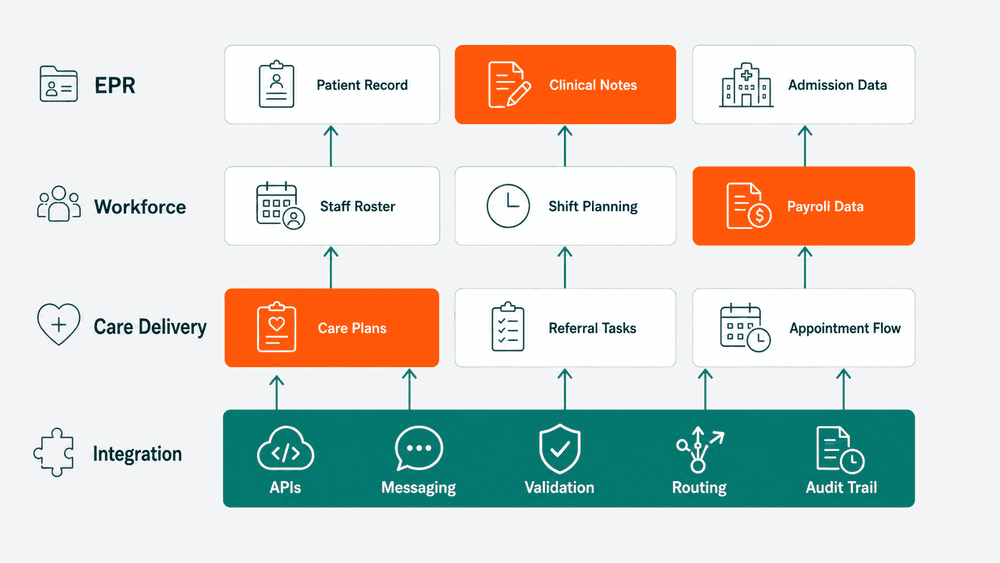
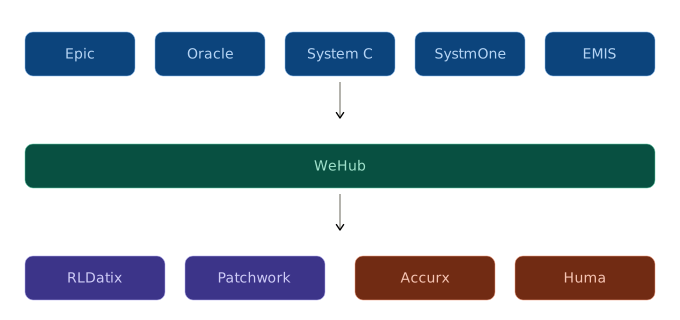
Workflow automation and integration purpose-built for NHS systems. ESR, Spine, PDS, e-RS, EPS, and HL7 to FHIR transformations delivered as configurable workflows rather than custom code. The category we sit in is iPaaS for healthcare, and the role on this list is the layer that makes the other nine talk to each other reliably without a six-month bespoke integration project for every change.
What the list actually shows
A few things become obvious once you put the platforms side by side.
Consolidation at the EPR layer is real but slower than the headlines suggest. Five EPR-adjacent vendors on a list of ten reflects the operational truth: most Trusts are running, replacing, or interoperating with at least two of these, and will be for the rest of the decade. The single-EPR-region pattern that the Somerset and Dorset Epic deal points toward is the direction of travel, not the current state.
The workforce layer is where the most disruption is happening right now. RLDatix represents the incumbent stack. Patchwork represents the structural challenge to it: AI-driven rostering that touches retention, agency spend, and clinician satisfaction in ways traditional e-rostering does not. The next two years will be loud here.
The platforms with the strongest NHS-native pedigree are not the ones with the largest marketing budgets. Accurx, System C, TPP, and EMIS solved a specific NHS problem at the specific moment clinicians and IT teams needed it solved. That is a useful filter when evaluating any new entrant.
Integration is no longer optional infrastructure. Epic, Oracle, RLDatix, Patchwork, Accurx, Huma: every one of these platforms publishes a significant integration surface, and every one assumes that surface will be consumed by another system in the Trust's stack. The platforms that lose ground in the next 24 months are the ones that still treat integration as an add-on engagement.
Where to start
The version of this article aimed at NHS IT Leads ends with one practical question, not a vendor recommendation. Look at your current digital architecture and ask which of these ten platforms you already run, which you have a procurement decision pending on, and which are sitting on someone's roadmap for the next 12 months. Three categories, ten platforms, one map of where your integration debt is going to surface.
That map is the conversation worth having before the next EPR business case or workforce procurement cycle. The healthcare SaaS platforms above will keep evolving. The Trusts that handle that evolution best will be the ones that decided early which seams in their architecture were worth investing in.
If integration across your ESR, EPR, and rostering stack is one of those seams, WeHub's team is worth a conversation.