


At some point, everyone near clinical data asks a version of the same question. A clinician asks why the thing they recorded gets coded again by someone else later. An analyst asks why the diagnosis field looks completely different in the data warehouse than in the record. A new integration analyst asks, quietly, whether SNOMED CT and ICD-10 are two names for the same thing.
They aren't, and the difference isn't trivia. It's two systems built for two different jobs, and most confusion around clinical coding dissolves once the jobs are clear.
In brief
SNOMED CT is a clinical terminology: a vast, structured catalogue of clinical meaning, built so care can be recorded precisely at the point it happens, in a form machines can compute over. It's the NHS's standard terminology for clinical records. ICD-10 is a statistical classification: a set of mutually exclusive categories built for counting things consistently, which is what mortality statistics, epidemiology and activity reporting need. They are complements, not rivals: record once in SNOMED CT, then derive the ICD-10 classification for the counting. Maintained maps exist to support exactly that direction of travel.
What SNOMED CT actually is
SNOMED CT is a terminology: an organised system of clinical concepts covering diagnoses, symptoms, procedures, findings, organisms, substances and more, each with a unique machine-readable identifier. Its purpose is precision at the point of care. When a clinician records a condition, SNOMED CT lets the record capture exactly what was meant, at whatever level of detail is clinically true, rather than forcing the reality into the nearest available bucket.
The scale is a feature, not a flaw. Clinical reality is enormous, and a terminology that wants to represent it faithfully has to be too. The consequence, covered in our terminology governance pieces, is that nobody ever uses SNOMED CT whole; you use governed selections of it, called value sets, chosen for each context.
Concepts, descriptions and relationships
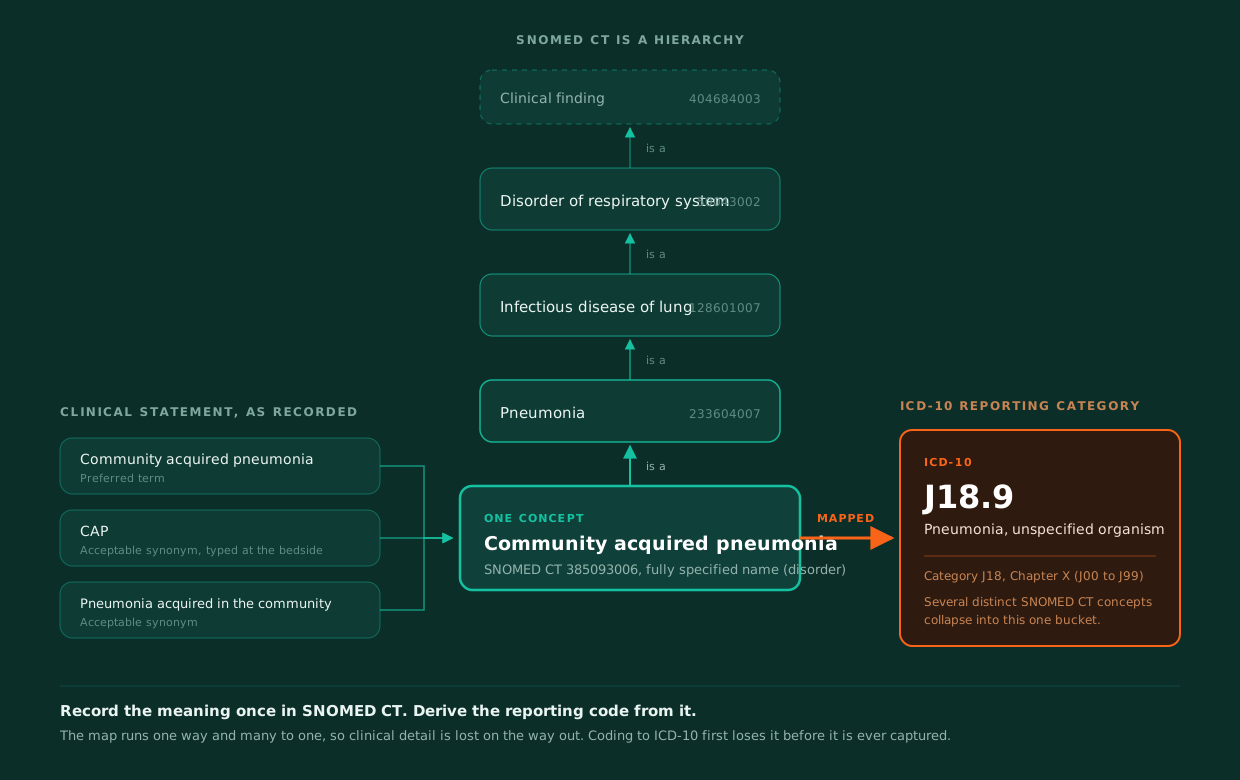
Three building blocks do all the work. A concept is a unit of clinical meaning with a unique numeric identifier that never changes its meaning. Descriptions are the human terms attached to a concept, and there can be many: the formal name plus the synonyms clinicians actually use. That's the quietly brilliant part: different people can record in their own words, and the system still lands on one shared code underneath. Relationships connect concepts to each other: every concept knows what kind of thing it is, and many carry defining attributes such as which body site or causative agent is involved.
That third block is what makes SNOMED CT more than a long list of codes. The meaning isn't just in the label; it's in the position and connections.
The hierarchy: why structure is the point
SNOMED CT concepts live in a hierarchy built on "is a" relationships, and a concept can have more than one parent, because clinical reality is like that: a single condition can legitimately be both a kind of infectious disease and a kind of respiratory disorder.
The payoff is computability. Because specific concepts sit beneath general ones, a system can ask questions at whatever level of generality the task needs: find every patient with any form of a condition, not just the exact code someone happened to pick. It's also what makes rule-based value sets possible: "this field accepts any descendant of this concept" is a definition that stays correct as the terminology grows. Structure, not size, is SNOMED CT's real point.
ICD-10: a different tool for a different job
ICD-10 is the International Classification of Diseases, and the word classification is doing all the work. A classification's job is counting: putting every case into exactly one category so that totals are comparable across hospitals, regions and countries, year after year. To do that well it must be the things a terminology must not be: coarser, mutually exclusive, and stable in shape.
So ICD-10 categories are deliberately broader than clinical reality, every case has one right place, and codes are typically assigned after the care episode by trained coders working from the record, because consistent counting is a discipline of its own. None of that is a weakness. It's the design brief. You cannot run national statistics on a terminology where everyone records at different depths, any more than you can run a nuanced clinical record on a few thousand statistical buckets.
SNOMED CT vs ICD-10, side by side
The contrasts line up cleanly once the jobs are clear. SNOMED CT records care; ICD-10 counts it. SNOMED CT is captured at the point of care, in the clinician's own words resolving to shared concepts; ICD-10 is generally assigned afterwards, from the record. SNOMED CT is fine-grained and multi-parented, built for expressing exactly what happened; ICD-10 is coarser and mutually exclusive, built so every case lands in one comparable bucket. SNOMED CT powers decision support, problem lists and analytics over live records; ICD-10 powers mortality and morbidity statistics, epidemiology and activity reporting.
And the two are formally connected: maintained maps run from SNOMED CT to ICD-10, so a record captured once in clinical terms can yield its statistical classification downstream, rather than being coded twice from scratch. Applied properly, that mapping happens at governed value-set scope through terminology tooling rather than ad hoc lookup, which is where this piece hands over to our terminology governance guide.
Where you'll meet SNOMED CT in the NHS
Everywhere clinical meaning is recorded or moved. GP systems have recorded in SNOMED CT for years; EPR problem lists, diagnoses and procedures increasingly do the same across secondary care. In integration work you'll meet it inside the payloads: as the coded content of FHIR resources, where UK Core profiles bind fields to SNOMED CT value sets, and inside HL7 v2 messages carrying coded entries. And you'll meet it in the infrastructure that serves it: terminology servers such as WeHub Term host SNOMED CT alongside ICD-10 and LOINC precisely so integrations can validate, look up and translate codes at runtime instead of hard-coding lists.
The bottom line
Stop asking which system is better; they're a pipeline. SNOMED CT captures what actually happened, richly and computably, at the moment of care. ICD-10 turns those records into comparable counts. Record once, classify downstream, and let maintained maps do the connecting. If you're new to this space, one exercise makes it concrete: take a single diagnosis, find it in both systems, and notice what each representation keeps and discards. The difference you see is the difference in the jobs.