
The demo always lands. A vendor shows your practice manager a no-code builder, she rebuilds your patient recall process in an afternoon, and for three months it runs beautifully. Then she moves to another Trust, the recall logic lives in a tool nobody else has logged into, IG asks where the data sits, and your IT team won't touch it because it sits outside the supported stack. The thing that saved time in week one is now a single point of failure with no owner.
That's the real shape of the no-code vs low-code healthcare decision. It's rarely made on a whiteboard with the trade-offs laid out. It gets made in a demo, by whoever felt the pain first, and the cost shows up later: in maintenance, in governance, and in the awkward question of who actually owns the workflow.
This piece is for the people who inherit that question: the NHS IT Lead, the Digital Lead, the CTO, the clinic manager weighing a build, the founder deciding where to spend engineering time. The aim isn't to crown a winner. It's to give you a way to match the approach to the task and to the governance environment you actually operate in.
You're probably asking the wrong question
"Should we go no-code or low-code?" sounds like a technology question. It's mostly an ownership and risk question wearing technology clothes.
No-code, low-code and AI agents aren't three competing products you choose between once. They're three different answers to three different problems: who builds it, how complex it's allowed to get, and how predictably it has to behave. A clinic that picks one as an identity ("we're a no-code shop") tends to force every problem through the same tool. That's how you end up with a recall workflow held together by twelve conditional rules nobody dares edit.
The better question is narrower and more useful: for this specific workflow, what's the right balance of speed, control, and auditability? Answer that per workflow and the category usually picks itself.
What each one actually is, in a clinic
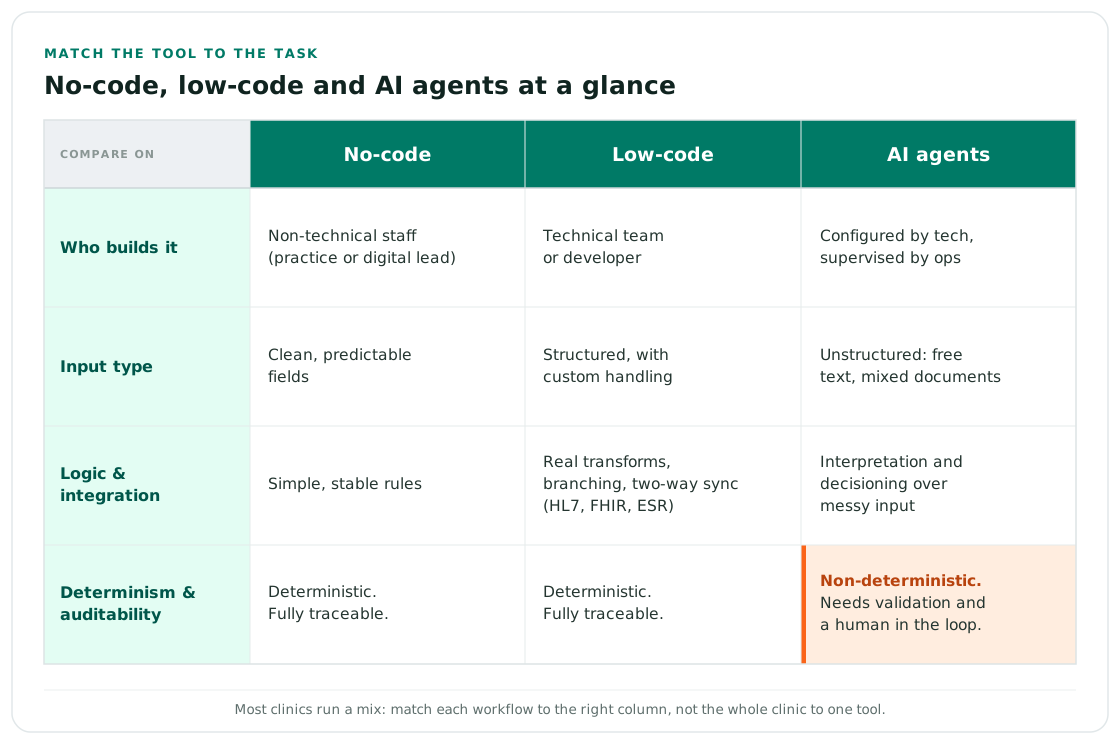
No-code is configuration without engineering. Drag-and-drop forms, visual automation ("when a referral arrives, create a task and notify the duty clinician"), dashboards a non-developer can assemble. The person building it is usually closer to the clinical or operational reality than to the codebase: a practice manager, a digital lead, an operations coordinator. Its real strength is speed for well-defined, stable processes. Its real weakness is the ceiling. The moment a process needs a genuine data transform, a conditional that branches six ways, or a two-way sync with ESR, no-code either fakes it badly or stops.
Low-code is engineering with the boilerplate removed. You still get a visual surface, but you can drop into code for the parts that need it: an HL7v2 to FHIR transform, a custom validation, a non-trivial API integration. The builder here is technical, or works alongside someone who is. Low-code earns its place where complexity is real but you don't want to write and maintain everything from scratch. Its failure mode is subtler than no-code's. Because the surface looks approachable, business users build past their depth, and the "low" in low-code quietly hides real engineering decisions about error handling, versioning, and what happens when a field is null.
AI agents are a different category altogether. Instead of you defining every branch, an agent interprets an input, decides, and acts, often over unstructured material that rule-based automation can't handle. Pulling structured data out of a free-text referral letter, triaging inbound messages by intent, drafting a first-pass response: these are tasks where the input is messy and the value is in interpretation. That's genuinely new capability. It also comes with a property that matters enormously in healthcare, which the next section is about.
The dimension everyone underweights: how predictably it behaves
In most industries you can weigh these approaches on speed and cost and stop there. In a regulated clinical environment you can't, because there's a fourth axis that quietly outranks the others: determinism.
No-code and low-code automations are deterministic. Given the same input, they produce the same output every time, and you can trace exactly why. That property isn't a nice-to-have when you're working inside DCB 0129 and DCB 0160 clinical safety obligations, DSPT requirements, and the basic expectation that you can answer "why did the system do that?" in an audit. A deterministic rule is its own explanation.
AI agents are non-deterministic by design. The same input can produce different outputs, and the reasoning is probabilistic rather than traceable the way a rule is. For a back-office task with a human checking the result, that's a manageable trade. For anything that touches clinical decision-making, patient safety, or an action that's hard to reverse, it changes the entire conversation. You're no longer just choosing a build tool. You're taking on a clinical safety case, a validation burden, and an accountability question about what happens when the agent is confidently wrong.
This is why "we're adopting AI agents" isn't a like-for-like swap for a workflow tool. The capability is real. The governance overhead is also real, and it lands on the IG lead and the clinical safety officer, not the vendor.
How to choose between no-code, low-code and AI agents
Run any candidate workflow through four questions, in order. The answers narrow the field fast.
- Who will own this in twelve months? If the honest answer is "a non-technical person who needs to change it without raising a ticket," you're in no-code territory, and you should accept its ceiling rather than fight it. If the answer is "the integration team," low-code is on the table.
- How structured is the input? Clean, predictable fields point to no-code or low-code. Genuinely unstructured input (free-text letters, mixed-format documents, natural-language messages) is where an AI agent earns its keep, if and only if a human stays in the loop on the output.
- How complex are the logic and the integration? A handful of stable rules: no-code. Real transforms, conditional branching, two-way sync with ESR or Spine, anything touching HL7 or FHIR: low-code, or a no-code platform with a serious integration engine underneath rather than a toy one.
- What does it cost if it's wrong, and can you trace why? This is the determinism gate. The higher the cost of a wrong output and the stronger the need to explain it, the harder you should lean toward deterministic approaches, and the more validation you should demand before an agent goes anywhere near it.
Most clinics find the honest answer isn't one approach but a mix: no-code for the simple, stable, business-owned processes; low-code for the integration-heavy work; AI agents, carefully scoped and supervised, for the messy interpretation tasks nothing else handles well. That isn't indecision. That's matching the tool to the task.
The part that ties it together
Here's what the category debate usually misses. Whichever approach you pick, the thing that decides whether it holds up is what sits underneath it: the integration layer connecting your tools to ESR, Spine, PDS, your EPR, and each other.
A no-code builder is only as good as the connectors beneath it. An AI agent that can't reliably read from and write to your clinical systems is a clever demo, not an operational tool. The reason a workflow built in week one becomes a liability by month six is almost never the surface tool. It's that the integration underneath was the happy-path kind: brittle, one-way, unmonitored, and undocumented.
This is the layer WeHub was built for, and it's also why the no-code versus low-code framing can be a distraction. A healthcare integration platform that gives non-technical staff a genuine no-code surface, lets engineers drop to low-code for the hard transforms, and can host supervised AI steps where they fit, all on one governed, audited set of connectors to ESR and Spine, sidesteps the choice. You're not buying a category. You're buying the layer that makes any of these approaches safe to run.
One grounded example of what that looks like in practice: a GP practice in the West Midlands cut administrative workload by around 30% within twelve weeks of putting the right automation in place, against an implementation cost under £9,000 and an annual saving of roughly £38,000. The headline is the saving. The reason it held is that it ran on integration built to be maintained, not just to demo.
The bottom line
No-code, low-code and AI agents aren't rungs on a ladder where the newest thing wins. They're tools for different jobs, and the no-code vs low-code healthcare decision only gets hard when you treat it as a single choice rather than a per-workflow one.
Pick one workflow that's currently causing friction. Run it through the four questions: who owns it, how structured the input is, how complex the logic, and what a wrong output costs. The right approach will be obvious by question four, and you'll have a repeatable way to make the next call without sitting through another demo.
If you're mapping how those workflows should connect to ESR, Spine, and your wider stack, the integration layer underneath is the conversation worth having, and WeHub's team is a good place to start it.