
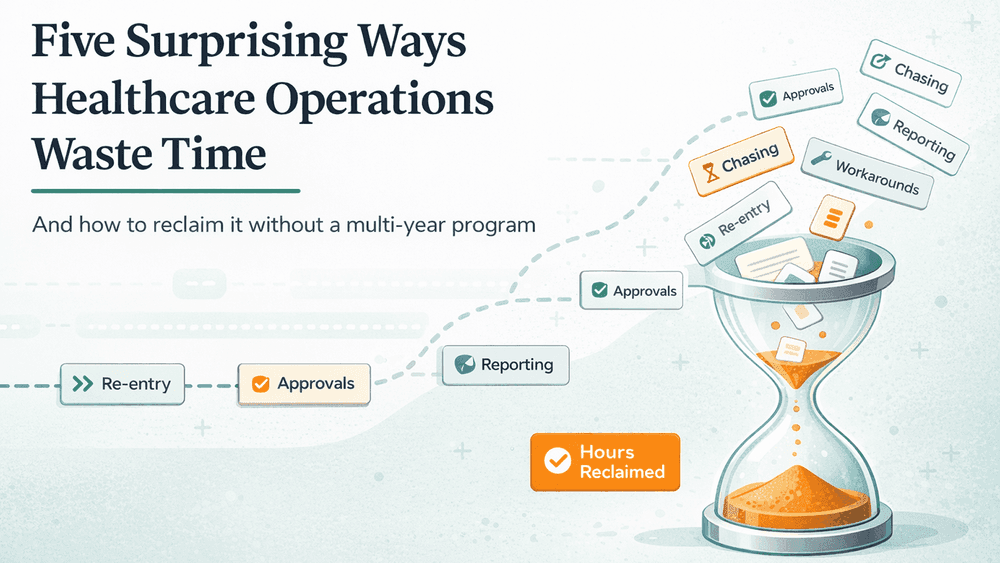
It's Not a Technology Problem. It's a Visibility Problem.
You already know your healthcare operations aren't running as smoothly as they could. You can feel it — in the escalations that shouldn't be escalations, in the workarounds your teams have built around systems that were supposed to help them.
But here's what makes this hard to fix: the waste doesn't announce itself. There's no single broken system. No red dashboard. Just hundreds of small frictions, repeated daily, across every service line. Each one feels minor. Together, they're costing your organisation thousands of hours a year.
The administrative burden in healthcare did not arrive all at once. It accumulated — one form, one approval layer, one "just in case" step at a time. And now it feels structural, like it cannot be unpicked without a major transformation.
It can. You just have to know where to look.
1. The Same Information, Entered Five Times
Somewhere in your trust right now, a member of staff is typing something into a system that already exists in another system ten metres away. Patient details copied from e-Referrals into PAS. ESR records manually re-keyed into a learning management platform. Discharge information transcribed from clinical notes into a spreadsheet for reporting.
Nobody planned this. It grew organically — each system was introduced to solve a real problem, but nobody joined them up afterwards. And your teams compensated. They became the integration layer.
You've probably considered fixing this. But connecting legacy systems feels expensive, risky, and slow. The last integration project took eighteen months and still didn't cover half the workflows.
Start smaller. Pick one data journey — say, the path a new starter record takes from ESR to your training system. Map every point where someone re-enters data. Then ask: what if we captured it once and let it flow? That single workflow might save your L&D team a full day every week. That is not transformation. That is one connection. And it is the foundation of healthcare automation basics — not a moonshot, just plumbing done properly.
2. Communication Everywhere, Clarity Nowhere
Your teams are communicating constantly — NHSmail, Teams, bleeps, phone calls, handover sheets. And yet the most common question in your organisation is still some version of: "Does anyone know what is happening with…?"
The problem is not that people are not talking. It is that none of it is connected to the work itself. A message about a patient discharge sits in someone inbox. A bed status update lives in a WhatsApp thread that half the team is not in. Critical context is scattered across five channels with no thread linking them.
You know centralising communication would help. But mandating a single tool feels heavy-handed, and your teams have already built habits that technically work.
You do not need to change the tools. Start by tying communication to one high-volume workflow — say, discharge coordination. When the status update lives inside the workflow rather than alongside it, people stop chasing and start acting. One workflow. One source of truth.
3. Schedules That Hide the Gaps
Your outpatient clinics look fully booked. But your consultants are telling you they are waiting between patients, finishing early, or seeing half the patients they expected. Meanwhile, your booking team is firefighting DNAs and last-minute cancellations all day.
This is one of the most costly clinic workflow problems in healthcare — and one of the hardest to see, because the schedule looks fine on paper.
The hesitation is understandable. Reworking scheduling logic feels like opening a can of worms — appointment types, room allocation, clinic templates. It touches everything.
But the first step doesn't. Pull your DNA data for one specialty. Look at the pattern — which day, which slot, which patient cohort. Then add automated SMS reminders for just that group. Trusts doing this routinely see DNA rates drop by 25–40%. You have not redesigned the schedule. You have just plugged the biggest leak.
4. Approvals That Exist Because They've Always Existed
A training request needs three signatures. A locum booking waits two days for a clinical director who is in theatre. A procurement form circulates for a week before someone realises it was already within budget authority.
You know some of these approval steps are unnecessary. But removing them feels politically difficult — especially in a culture built around clinical governance and audit trails.
You don't have to remove them. Start by measuring them. Track how long each approval stage takes for one process — say, non-clinical procurement under £500. When you can show the board that a routine request takes nine days to travel through three inboxes, the conversation changes. Visibility creates permission to simplify. Then automate the low-risk tier with a rule-based workflow, and suddenly your managers are spending time on decisions, not signatures.
5. Data That Only Tells You What Already Went Wrong
Your board pack arrives monthly. It tells you last month 4-hour A&E performance, last month RTT position, last month elective cancellations. By the time anyone reads it, the moment to intervene has passed.
You have probably looked at dashboards and BI tools. But the data lives in so many systems — PAS, ESR, finance, workforce — that building a real-time view feels like a major infrastructure project.
It doesn't have to be. Pick one operational metric — say, theatre utilisation or clinic fill rate — and automate just that feed. Give it to the service manager, not the board. When one team starts making decisions from live data instead of last month spreadsheet, the value becomes obvious. Others follow.
The Pattern Here Is the Point
None of these five problems are surprising. You have seen every one of them. The reason they persist is not ignorance — it is that the fix always seems to require a programme, a business case, a steering group.
It does not. Every section above starts with one workflow, one metric, one connection. That is how you begin reducing healthcare workflow inefficiencies — not by boiling the ocean, but by proving that small changes return real time to real teams.
The organisations making progress on this are not the ones with the biggest budgets. They are the ones that started.