


The compliance report nobody trusts
A ward manager opens the monthly statutory and mandatory training report and sees a nurse flagged red for fire safety. The nurse completed it three weeks ago and has the completion certificate on her phone. The manager raises it with learning and development, who check the learning platform and confirm the completion. The report is still red.
Multiply that by a ward, then a division, and the compliance report stops being trusted. Managers keep their own spreadsheets, staff are chased for training they have already done, and the figure that goes to the board is quietly caveated in every conversation about it.
Nobody in that chain did anything wrong. The completion happened in one system, the compliance record lives in another, and the hand-off between them failed silently. That makes it an ESR training records integration problem, not a training problem.
What the training record actually is
In most Trusts, the answer to "is this person compliant" lives in ESR as a competency. For statutory and mandatory training, those competencies are national and aligned to the Core Skills Training Framework (CSTF), which exists so that training completed in one NHS organisation can be recognised in another. Organisations that have declared alignment to the CSTF record that training against national competencies in ESR. Each competency carries its own renewal period, such as fire safety every two years or information governance every year.
The courses that produce the evidence happen elsewhere: e-learning inside ESR, national e-learning, a local learning platform, or a face to face session with a sign-in sheet. When staff move between organisations, the inter-authority transfer carries their CSTF-aligned competencies across. Reporting then usually runs from the data warehouse, not from ESR directly.
So one fact, "this person is in date for fire safety", depends on at least three hand-offs. Each one can fail without anyone noticing.
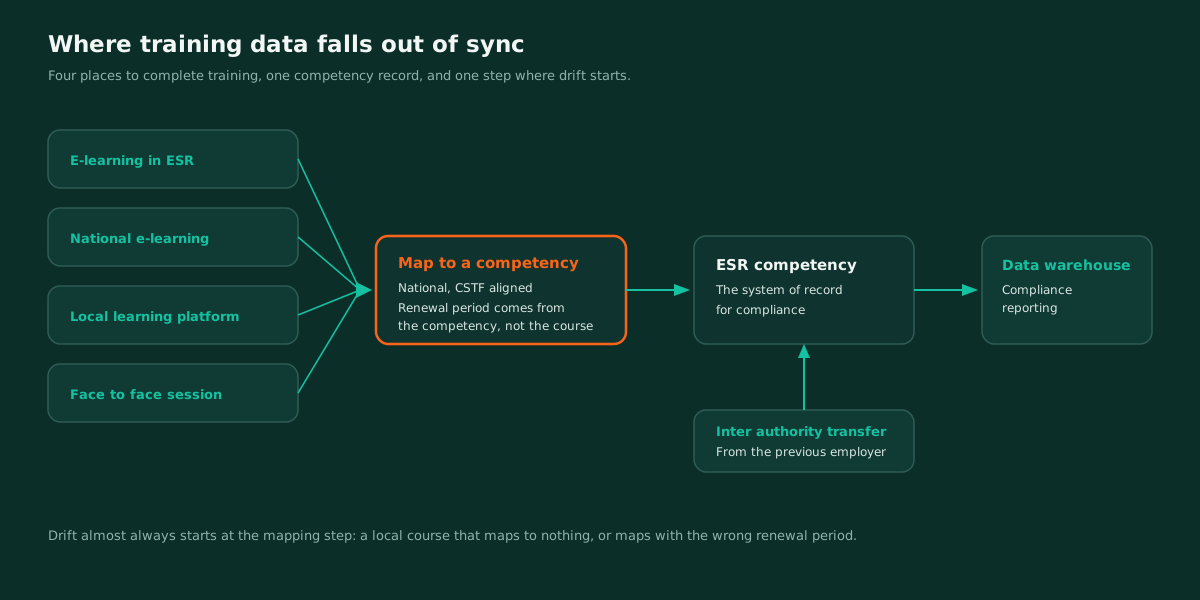
Six places training data falls out of sync
- A local course maps to nothing. A Trust builds its own version of a subject on its local learning platform and nobody maps it to the national competency. Staff complete it, and ESR never hears about it.
- The renewal period comes from the course, not the competency. The local course is set to expire after three years. The national competency expires after two. For a year, the two systems disagree about whether the person is in date.
- Completions never make it back. Face to face sessions recorded on paper, or completions in a platform that exports to ESR on a weekly file, arrive late or not at all.
- Transferred competencies aren't recognised. The inter-authority transfer brings competencies in, but a local rule or a mismatched competency name means they don't count towards local compliance.
- Staff with more than one assignment. Bank staff and people with multiple posts can have compliance assessed per assignment, so a completion recorded against one doesn't show against the other.
- Reporting runs from a stale copy. The data warehouse loads a snapshot. The ward report is right about the snapshot and wrong about today.
The pattern that holds
The Trusts that stop arguing about compliance figures tend to share the same design, whichever tools they use.
The ESR competency is the system of record. Courses are evidence. The competency, with its national renewal period, is the answer to the compliance question, and every report reads from it.
Mapping is done once, centrally, and checked. Every course on every platform is mapped to a national competency where one exists, and an unmapped completion is treated as an error to resolve, not a gap to ignore.
Completions move as events, not batches. When a completion is recorded, it flows to ESR promptly, rather than waiting for a weekly file. Where a file is unavoidable, every row is validated and every rejected row goes to a named person.
A daily reconciliation compares sources. Learning platform completions, ESR competencies and the data warehouse are compared, and every disagreement is listed with the person and the subject. It doesn't fix anything automatically. It makes drift visible while it is still small.
Every change is logged at field level. When a competency date changes, the record shows what changed, from what, and why. That is what turns "why is she red?" into a two-minute answer rather than a ticket.
What to do first
Don't start with all of it. Pick one CSTF subject, information governance is usually a good choice because access often depends on it, and one ward.
For that ward, compare three lists: completions on the learning platform, competencies in ESR, and compliance in the data warehouse report. Every disagreement you find will fall into one of the six categories above, and the pattern of disagreements will tell you which hand-off to fix first.
If you want to see that reconciliation built as a configured flow, the ESR processors in WeHub Studio are a reasonable place to start the conversation.