

Most NHS automation starts with a sensible goal. A team is drowning in manual rekeying, someone builds a workflow to move data between two systems, and the immediate problem goes away. The workflow works. It keeps working. And somewhere in the months after go-live, it quietly becomes part of how patient data moves through the Trust, without ever appearing on a data flow map.
That is the uncomfortable truth about healthcare data privacy in automated workflows. The privacy controls most Trusts rely on were built for a slower world, one where a person sat between the data and its destination and made a judgement before anything moved. Automation removes that person. It does not remove the obligation.
This piece is for the IT Lead, Digital Lead, or CTO who owns the integration estate and keeps being asked whether the automation that makes everything faster is also making something quietly riskier. It can be. And the places it goes wrong are predictable once you know where to look.
The workflow nobody put through a DPIA
Picture the workflow connecting your patient administration system to a downstream operational tool. It pulls demographics, confirms identity against PDS, and pushes a record into a task queue. When the project that created it went live, it had a DPIA, sign-off from the IG Lead, and a clear lawful basis.
Then it got reused. Someone pointed a second consumer at the same feed because it was already there. A field was added to the payload to save building another integration. A copy started landing in a monitoring store so the team could debug failures. None of those changes felt big enough to reopen the DPIA. Each one moved a little more patient identifiable data a little further than the original assessment covered.
By the time anyone asks the question, nobody can fully say which patient data this workflow touches, where every copy now lives, or who can read it. That is not a failure of the people involved. It is what happens when privacy is treated as a property of the project rather than a property of the workflow that outlives it.
Why is healthcare data privacy now a workflow problem?
Two things shifted under the surface, and both raise the stakes for automation specifically.
First, the regulatory ground moved. The Data (Use and Access) Act 2025 rewrote the UK GDPR rules on solely automated decisions, with most provisions live from February 2026. For decisions that do not involve special category data, the rules are now more permissive. For decisions that do involve it, and health data is special category data, the narrow routes still apply: you generally need explicit consent or contractual necessity, plus safeguards that let the patient be told about the decision, contest it, and obtain human intervention. The moment a workflow stops moving data and starts shaping a decision about a patient, triage routing, eligibility flags, prioritisation, it walks into that territory. Plenty of Trusts have automation doing exactly this without anyone framing it as automated decision-making.
Second, the assurance model moved with it. The CAF-aligned DSPT is outcome-based now, not a checklist, and it carries a dedicated objective, Objective E, on using and sharing information appropriately. Outcome-based assurance is unforgiving of automation you cannot explain. It is no longer enough to assert that a data flow is appropriate. You have to be able to show, workflow by workflow, that it is.
Put those together and the conclusion is plain. Privacy is no longer something you assess once at the edge of a system. It is something each automated workflow either has or does not, and increasingly something you have to be able to demonstrate.
The privacy controls automation quietly bypasses
These are not exotic failures. They are everyday controls that depended, often invisibly, on a human in the loop. Automate the loop and they fall away unless you rebuild them deliberately.
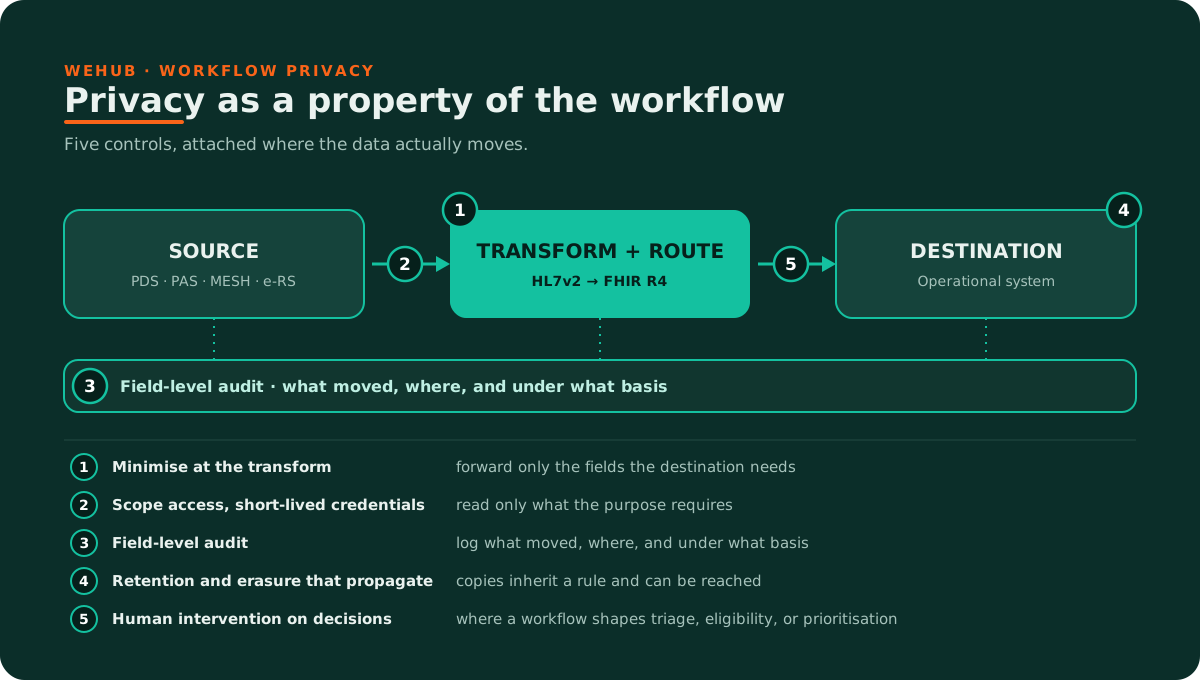
- Data minimisation at the transform. A person copies the one field they need. A workflow copies the whole payload. When an HL7v2 message is transformed to FHIR R4 and handed downstream, the easy path carries every segment across, including free-text and identifiers the destination has no business holding. Minimisation is a decision made at the transform, and by default it usually is not made at all.
- Purpose limitation across reuse. A feed built for one lawful purpose gets pointed at a second consumer because it already exists. The data flows fine. What does not flow with it is the lawful basis, the Caldicott justification, or the patient-facing transparency that made the original use legitimate. The second use can be unlawful even when every byte is correct.
- The confidentiality judgement that used to happen by default. An experienced clinician or administrator carried an instinct for when something should not be shared. That instinct was a control, even though nobody wrote it down. Automation executes the rule it was given, not the judgement the rule stood in for. If the rule is slightly too broad, it is now too broad several thousand times a day.
- Field-level audit. Most integration logging answers "did the job run?" Privacy asks a different question: whose data, which fields, went where, and who could read it? Job-level logging cannot answer that. When an incident or a subject access request arrives, the gap between a short conversation and a painful one is whether you logged at the field level or only the file level.
- De-identification done at speed. Pseudonymisation is easy to get wrong and easy to assume you got right. A workflow that strips an NHS number but leaves a rare diagnosis, a postcode, and a date of birth has anonymised nothing. By hand, that slip happens occasionally. Built into a workflow, it happens to every record that passes through, consistently and invisibly.
- Retention and erasure that never propagate. Automation multiplies copies. The original record has a retention schedule. The copy in the downstream tool, the row in the monitoring store, the cached lookup result, usually do not. When a records management obligation or an erasure request lands, you can only honour it for the copies you know about, and an automated estate tends to have copies nobody mapped.
Where it actually leaks: a referral intake workflow
Make it concrete. Imagine a referral intake workflow, the kind many Trusts run to take pressure off an admin team.
A referral arrives, perhaps through MESH or e-RS. The workflow runs a PDS trace to confirm the patient and enrich the record, routes the referral into a local system, and writes a row to a queue so throughput can be tracked. Useful, fast, defensible on paper.
Now look at where it leaks. The PDS trace returns a full demographic record when the task needed only enough to confirm a match, so more identifiable data enters the pipeline than required. The enriched payload, NHS number plus demographics plus the clinical reason for referral, lands in a tracking system whose access list is wider than the referral team, because it was set up for operational visibility, not confidentiality. A copy of the raw message sits in the integration logs in clear, ready to replay if something fails. And the audit trail records that a referral was processed, not which fields were exposed or to whom.
Nothing there is malicious or even careless. Every step had a reason. But the cumulative result is patient identifiable data spread wider than necessary, retained longer than intended, and logged in a way that cannot reconstruct what happened. That is healthcare data privacy failing at the integration layer, which is exactly where it is hardest to see.
What good looks like: privacy as a property of the workflow
The Trusts that handle this well do not treat privacy as a review they pass. They treat it as a property they can point to in the workflow itself. In practice, five things tend to be true.
They minimise at the point of transform, not after the fact. The workflow forwards only the fields the destination genuinely needs, and that choice is explicit and reviewable rather than a side effect of copying everything.
They scope access tightly and keep credentials short-lived. The workflow reads only what its purpose requires, the credential it uses is scoped to that purpose, and it does not outlive the need. An over-privileged integration account is a privacy risk before it is ever a security one.
They log at the field level. When data moves, the event captures what moved, where it went, and under what basis, so "who saw this patient's data?" is a query rather than an investigation. This is also what makes an outcome-based DSPT conversation short instead of defensive.
They make retention and erasure first-class. Copies created by automation inherit a retention rule and can be reached by an erasure request, because the workflow knows where it put them.
And they treat any workflow that shapes a decision as a decision, with the safeguards that now come with it: a clear lawful basis for the special category data involved, transparency to the patient, and a route to human intervention.
This is the kind of property WeHub builds workflows to have, with minimisation, scoped access, and field-level audit as defaults rather than retrofits. The pattern matters more than the tool, though. Any Trust running serious automation over patient data should be able to point to these five properties in its own architecture, whatever it was built with.
The bottom line
Automation is not the enemy of privacy. Automation without privacy designed into it is. The reason this matters more now is simple: the workflows are multiplying, the assurance model expects you to explain them, and patient data does not become less sensitive because a machine moved it instead of a person.
If you want one place to start, take a single live workflow that touches patient identifiable data and answer three questions. What is the minimum data it actually needs? Who can read every copy it creates? Could you reconstruct, at the field level, what it did last Tuesday? If any answer is uncomfortable, you have found the work. The pattern you build to fix that one workflow is the one you will reuse for every automated flow that moves patient data across your Trust.