AI workflow automation in healthcare isn't a future state. These seven use cases are already solving real operational problems across NHS Trusts and digital health teams.
Why Most AI Conversations in Healthcare Miss the Point
There's a particular kind of meeting that happens in most NHS Trusts at least once a quarter. Someone from the digital team presents a slide about AI. The slide mentions "transformative potential." The CTO nods. The IG lead raises a concern about data governance. Everyone agrees it's important. Nothing ships.
The problem isn't that AI doesn't work in healthcare. It's that most conversations about it start at the wrong altitude. They talk about machine learning models and predictive analytics as though the hard part is the algorithm, when the hard part is actually getting clean data from System A to System B without something breaking at 2am on a Sunday.
AI workflow automation in healthcare gets interesting when you stop treating AI as a destination and start treating it as a layer inside the integration work you're already doing. Not a new project. An upgrade to the plumbing.
Here are seven use cases where that's already happening, grounded in the systems, roles, and friction that NHS digital teams actually deal with.
1.Intelligent HL7 and FHIR Message Routing
Most integration engines route messages based on static rules. Message type ADT^A01 goes here. ORM^O01 goes there. It works until it doesn't, and it stops working the moment message volumes spike, edge cases multiply, or a new sending system introduces subtle formatting variations that break your parsing logic.
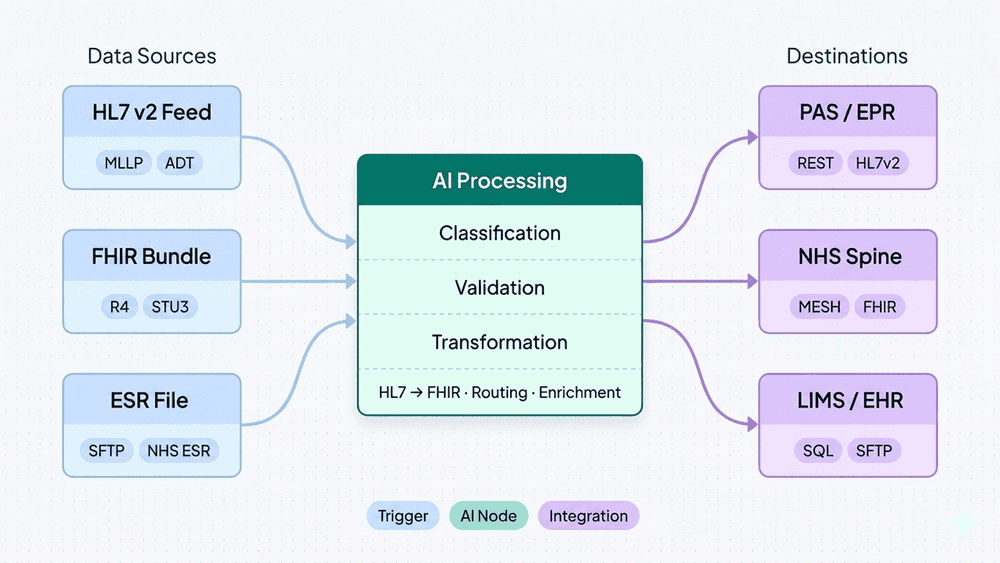
AI adds a classification layer before routing. Instead of rigid pattern matching, a trained model evaluates message content, sender context, and historical routing patterns to determine the correct destination. When an HL7v2 message arrives with a malformed segment or an unexpected value in MSH-9, the system doesn't just fail and log an error. It classifies intent, flags the anomaly, and routes accordingly, or quarantines intelligently rather than silently dropping data.
For teams managing HL7 to FHIR transformations across multiple Trust endpoints, this reduces the volume of "mystery failures" that eat up developer time every Monday morning.
2.Automated ESR Data Validation and Reconciliation
Anyone who's worked with ESR files knows the pain. Staff records arrive via SFTP, get parsed, and feed into downstream workforce systems. On paper, the schema is well defined. In practice, you get missing National Insurance numbers, mismatched assignment numbers, role codes that don't align with the receiving system's expectations, and date formats that shift between files from different Trusts.
The AI workflow automation layer healthcare teams are now deploying sits between the parse step and the outbound push. A validation model trained on historical ESR data flags records that are structurally valid but semantically suspect: a clinician whose grade code doesn't match their assignment category, or an onboarding record where the start date precedes the DBS check date. These aren't things a static rule catches easily because the logic is contextual, not binary.
The downstream effect: fewer rejected records at the receiving end, fewer manual reconciliation hours for workforce teams, and faster onboarding cycles.
3.Predictive Workflow Failure Detection
Here's a pattern most integration teams know too well. A workflow runs fine for weeks. Then one morning, it starts failing intermittently. The logs show a timeout. The timeout traces back to a downstream API that's responding slowly. The slow response traces back to a database that's approaching capacity. By the time someone notices, there's a backlog of 400 unprocessed messages and a clinical team asking why their data hasn't updated.
Predictive failure detection uses historical execution data such as run times, payload sizes, error rates, and response latencies to flag workflows that are drifting toward failure before they actually break. The model doesn't need to understand clinical context. It needs to understand that when average execution time for Workflow X creeps from 1.2 seconds to 3.8 seconds over 48 hours, something upstream or downstream has changed and a human should look at it now, not after the queue backs up.
This is one of the highest value AI use cases in healthcare integration because it converts reactive firefighting into proactive intervention, and firefighting is where most integration teams spend a disproportionate share of their week.
4.AI Powered Discharge Coordination
Discharge is where workflow automation meets clinical reality at its messiest. A single discharge event touches PAS, pharmacy, transport, social care referrals, GP notification via GP Connect or Spine, and sometimes community nursing. Each system expects data in a different format, at a different time, through a different channel.
AI workflow automation in healthcare adds coordination intelligence. Rather than firing all downstream notifications the moment a discharge decision is recorded, an AI layer sequences the workflow based on patient context. Does this patient have a complex care package? Route the social care referral first and delay the GP notification until the package is confirmed. Is the pharmacy dispense complete? Hold the transport booking until it is.
The AI isn't making clinical decisions. It's optimising the order and timing of operational steps that clinicians and operational managers currently coordinate manually, often via phone calls and spreadsheets. The time saving is real: discharge teams in Trusts piloting this approach have reported reducing coordination overhead by 30 to 40 percent for complex discharges.
5.Smart Duplicate Detection Across Patient Records
PDS lookups catch a lot. But not everything. When data flows in from multiple feeder systems such as A&E, outpatient booking, and GP registration, you get records that aren't exact duplicates but refer to the same patient. Different spellings. Transposed digits in an NHS number. A maiden name on one record and a married name on another.
Traditional matching uses deterministic rules: exact NHS number match, or exact name plus date of birth. AI based probabilistic matching scores record pairs on multiple weighted attributes simultaneously, including phonetic similarity, address proximity, and demographic plausibility, and surfaces likely duplicates for human review rather than silently merging or silently ignoring.
This matters most at scale. A Trust processing thousands of registrations weekly can't manually review every near miss. AI narrows the review queue to the records that actually need a human decision.
6.Natural Language Triage for Unstructured Clinical Data
A significant portion of clinical data arrives as free text. Referral letters. Discharge summaries. Clinic notes pasted into HL7 OBX segments. This data is rich with clinical value and almost impossible to route or act on programmatically without human interpretation.
Natural language processing models can classify unstructured text by urgency, speciality, or required action, and feed that classification into a workflow engine as structured metadata. A referral letter mentioning "suspected malignancy" gets flagged and routed differently from one describing "routine follow-up." The model doesn't replace clinical triage. It accelerates the first sort, so that the clinical team reviewing referrals spends their time on decision making rather than reading and categorising.
For digital health teams building referral management or clinical correspondence workflows, this is where AI use cases healthcare organisations are most actively exploring right now, because the ROI is immediate and the risk profile is manageable: the AI classifies; a human confirms.
7.Automated Compliance Monitoring and DSPT Evidence Collection
DSPT submissions, CQC readiness, and GDPR audit trails mean compliance is a recurring operational tax that digital teams absorb alongside everything else. The evidence collection alone is brutal: who accessed what, when, through which system, and was the access justified?
AI workflow automation can continuously monitor access patterns, flag anomalies such as a user accessing records outside their normal department or shift pattern, and auto generate evidence logs structured for DSPT submission categories. Instead of a quarterly scramble to pull audit data from six systems, the compliance evidence accumulates in real time, structured and ready for review.
This doesn't eliminate the IG lead's role. It eliminates the IG lead's least valuable work, the manual aggregation, and frees them to focus on policy, training, and genuine risk assessment.
What Connects All Seven
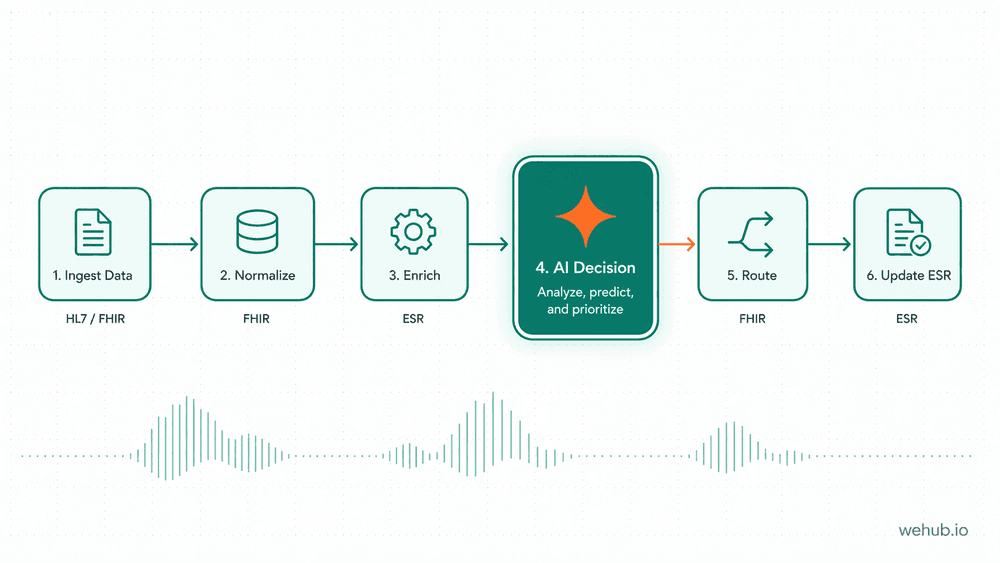
Every use case above shares the same structural pattern: AI isn't replacing a workflow. It's sitting inside one, as a processing step that makes the workflow smarter without changing its fundamental architecture.
That's the insight most AI conversations in healthcare miss. You don't need to build an AI system. You need to add AI capabilities to the integration and automation systems you already operate. The workflow engine stays. The connectors stay. The data flows stay. AI becomes a node in the pipeline, classifying, validating, predicting, or routing, not a separate initiative with its own project board and its own budget line.
For NHS digital teams, this is the practical path. Not "implement AI." Instead: identify the workflow that breaks most often, or costs the most human hours, or produces the most downstream errors, and ask whether a classification, prediction, or validation model inside that workflow would reduce the damage.
Where to Start This Week
Pick one workflow. Not your most complex. Not your most politically sensitive. Pick the one where your team spends the most time on manual triage, validation, or error recovery. Map the data flow. Identify the step where a human is essentially doing pattern matching that a model could assist with. That's your first AI use case, and it's probably smaller and more achievable than the one on the slide deck from last quarter's board meeting.
If you're exploring where AI fits into your integration architecture, WeHub's team works with NHS Trusts on exactly this kind of operational mapping, worth a conversation before you commit to a roadmap.