This article targets senior integration architects, Digital Programme Managers, and CTOs at NHS Trusts and digital health organisations who are evaluating where generative AI fits into their existing integration infrastructure. The reader is assumed to be technically literate, familiar with HL7, FHIR, and ESR, and sceptical of AI hype. The tone is deliberately practical and governance aware. The CTA is soft: one sentence, no urgency language, no product feature list.
The Real Problem Generative AI Solves in Integration
There's a meeting that happens in most NHS integration teams at least once a quarter. Someone pulls up a spreadsheet of pending data mappings. HL7 ADT messages that need translating into FHIR resources. ESR files with fields that don't quite match the schema the receiving system expects. Transformation logic that was written two years ago by someone who's since moved on, and nobody's entirely sure what the edge cases are.
The backlog grows. The team doesn't.
That's the gap where generative AI healthcare integration is starting to matter. Not as a replacement for the integration engine, not as a magic button that "automates everything," but as a tool that absorbs the repetitive, pattern heavy work that burns hours every week.
This guide is for the teams already deep in the plumbing. If you know what an HL7 OBX segment is, this is for you.
What Generative AI Actually Does in a Healthcare Integration Stack
Let's be specific. When people say "generative AI in healthcare," they often mean chatbots or clinical decision support. That's a different conversation entirely.
In the context of integration, generative AI refers to large language models applied to structured and semi structured health data tasks: interpreting message schemas, suggesting field mappings, generating transformation logic, summarising error logs, and producing documentation from existing workflows.
It doesn't run your integration pipeline. It sits alongside it, handling the cognitive overhead that slows your team down.
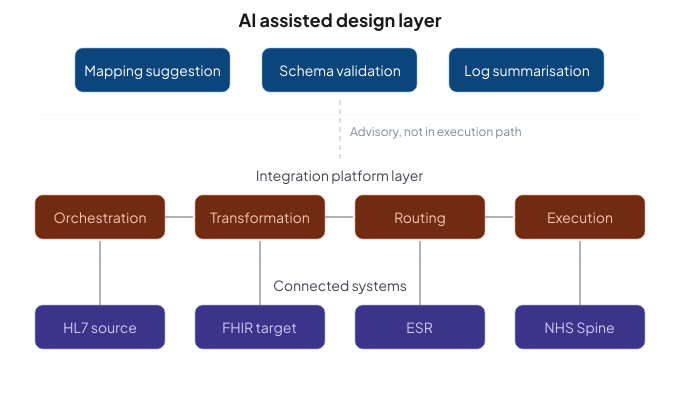
Think of it this way: your integration platform handles orchestration, routing, and execution. Generative AI handles interpretation, suggestion, and explanation.
Where AI Interoperability in Healthcare Gets Practical
The interoperability challenge in the NHS isn't a lack of standards. HL7v2 exists. FHIR R4 exists. The problem is that every Trust, every supplier, and every legacy system implements those standards slightly differently.
That's where AI interoperability healthcare use cases start to land. A generative model trained on HL7 and FHIR schemas can look at an incoming message structure and suggest mappings to a target FHIR resource, flagging segments that don't conform to the expected profile. It won't get it right every time, but it gets the first 80% done in seconds rather than hours.
For integration architects, this changes the shape of the work. Instead of building every mapping from scratch, you're reviewing and refining AI generated suggestions. The skill required doesn't decrease. The time per task does.
AI Health Data Transformation: Three Use Cases That Work Today
Here's where teams are already seeing returns:
- HL7 to FHIR mapping acceleration. When a Trust receives HL7v2 ADT or ORU messages and needs to push FHIR R4 resources to a downstream system, the mapping work is predictable but tedious. Generative AI can parse the source message, identify segment and field relationships, and draft the transformation logic. The integration engineer reviews, adjusts for local extensions, and deploys. Time savings on initial mapping: roughly 40 to 60 percent in reported cases.
- ESR file interpretation and validation. ESR extracts are notoriously inconsistent across Trusts. Field ordering varies, optional fields appear and disappear, and character encoding issues are common. A generative model can pre scan an ESR file, flag anomalies against the expected schema, and suggest corrective parsing rules before the file hits your main pipeline. This catches errors that would otherwise surface as failed workflow runs or, worse, silently corrupt downstream records.
- Integration log summarisation. Nobody reads every log line. When a workflow fails at 2am, the on call engineer needs to know what happened, which node failed, and what the payload looked like. Generative AI can summarise a verbose log trail into a two paragraph explanation with the root cause highlighted. It's not replacing observability tooling. It's making the output of that tooling useful faster.
Where Generative AI Falls Short (And Why That Matters Clinically)
This is the section most vendors skip. Here's what generative AI can't do reliably in healthcare integration today:
It can't guarantee correctness. LLMs hallucinate. In a clinical data context, a hallucinated field mapping doesn't just break a workflow. It can route incorrect patient data to a clinical system. Every AI generated transformation must be validated by a human before it touches production data. Full stop.
It can't handle novel edge cases. If your Trust has a bespoke ESR extension or a nonstandard HL7 segment, the model won't have seen it before. It'll guess, and the guess will look plausible. That's more dangerous than an obvious error.
It can't replace governance. AI generated logic still needs to pass through your IG review, your DSPT alignment checks, and your clinical safety assessment. The speed gain upstream doesn't compress the governance timeline.
Governance, GDPR, and the Trust Question
Any generative AI tool that touches NHS patient data needs to answer three questions clearly:
Where is the data processed? If patient identifiable data leaves your cloud boundary to reach a third party LLM, that is a GDPR and DSPT issue before it is a technology issue. Integration teams should insist on models that run within their existing Azure or on premise environment, or that operate only on de identified schema metadata rather than live patient payloads.
Who reviews the output? AI generated mappings and transformation logic must have a named reviewer. Audit trails matter. If CQC or an IG audit asks who approved the logic that routes PDS data, "the AI did it" is not an acceptable answer.
What happens when it's wrong? You need rollback paths. Version controlled workflows, diff visibility on any AI suggested change, and the ability to revert to the last human approved state. This isn't optional. It's the baseline.
What Good Looks Like: Fitting AI Into Your Existing Workflow
The teams getting value from generative AI healthcare integration aren't rebuilding their stack. They're adding a layer.
The pattern looks like this: an integration platform handles orchestration and execution. AI tooling plugs into the design phase, where it suggests mappings, flags data quality issues, generates boilerplate transformation logic, and documents existing workflows. The integration engineer remains the decision maker. The AI is an accelerator, not an authority.
This matters because it means you don't need to rip and replace anything. You need a platform that's extensible enough to support AI assisted design alongside deterministic execution. That's the architecture that scales without introducing clinical risk.
The Decision You're Actually Making
The question isn't whether generative AI will affect healthcare integration. It already is. The question is whether your team adopts it deliberately, with governance guardrails and clear human oversight, or whether it creeps in through individual workarounds and shadow tooling that nobody's reviewed.
Start with one bounded use case. Pick the task your team spends the most time on that is also the most pattern heavy: HL7 to FHIR mapping, ESR validation, or log triage. Run a controlled pilot with human review on every output. Measure time saved and errors caught.
That's the move. Not a platform overhaul. One use case, one team, one month. The data will tell you where to go next.
If your integration stack already handles HL7, FHIR, and ESR workflows, and you're thinking about where AI fits into that picture, WeHub's team is worth a conversation.