Written for NHS IT Leads, Digital Programme Managers, CTOs at NHS Trusts and digital health solution providers. Assumes familiarity with HL7, ESR, PDS, and NHS governance frameworks. TOFU stage: builds authority and frames the problem without product selling. Suitable for organic search, LinkedIn distribution, and newsletter inclusion.
The pitch versus the reality
There is a version of this conversation that happens in every NHS Trust digital board meeting right now. Someone presents a slide about AI agents. The language is bold: autonomous decision making, intelligent orchestration, self healing workflows. The CTO nods cautiously. The IG lead shifts in their seat. The IT operations manager quietly wonders which system is going to break first.
The term "AI agents in healthcare" has become the most overloaded phrase in health tech. Vendors are attaching it to everything from simple rule engines to genuinely autonomous workflow components. For NHS IT leads and digital programme managers, the challenge is not whether AI matters. It does. The challenge is separating what is real, what is emerging, and what is still a conference slide masquerading as a product.
This piece is a practical assessment. No hype, no dismissal. Just a clear look at where AI agents fit inside healthcare workflow automation today, what they actually require to function, and where the gap between promise and production remains wide.
What "AI agent"; actually means in a healthcare workflow
Strip away the marketing and an AI agent is a software component that can perceive its environment, make decisions, and take actions with some degree of autonomy. In healthcare workflows, that translates to a component that can observe data flowing through a pipeline, interpret context, and decide what to do next without a human manually configuring every branch.
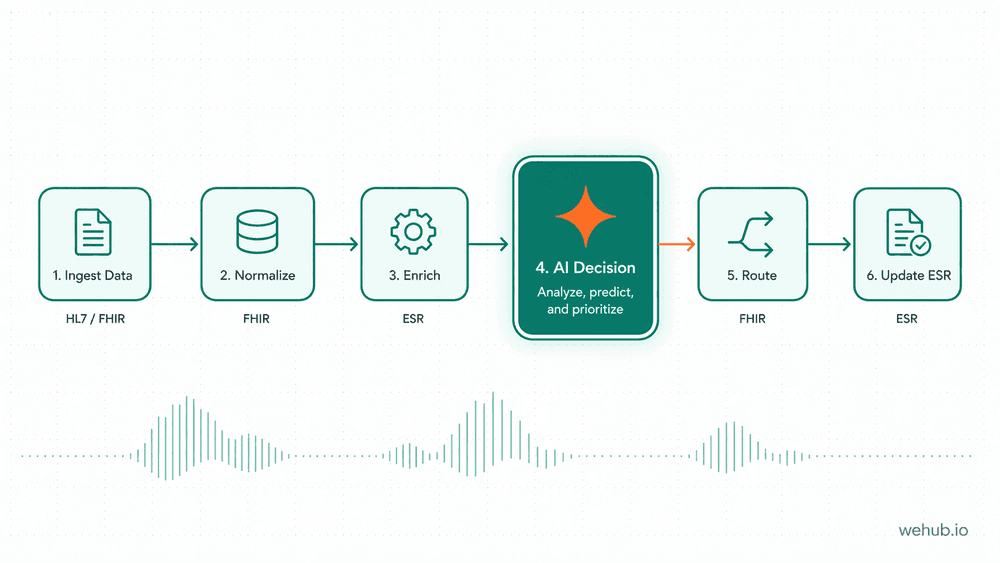
The key distinction is between AI assisted tooling and truly agentic behaviour. An AI model that summarises a clinical document when triggered is a tool. An AI component that monitors incoming HL7 ADT messages, identifies anomalies in patient demographic data, flags discrepancies against PDS records, and routes exceptions to the right team without being explicitly told which exception maps to which team: that is closer to agentic.
Most of what is sold as "AI agents" in healthcare today sits firmly in the first category. Useful, yes. Agentic, not yet.
Where AI agents deliver real value in NHS operations
There are specific operational zones where AI workflow automation in healthcare is already proving its worth, even if the implementations are more modest than the pitch decks suggest.
Data quality and exception handling. ESR file processing is a good example. Trusts receive workforce data in complex, structured formats that frequently contain edge cases: missing registration body codes, mismatched pay scales, records that do not conform to expected schemas. Today, most of these exceptions are caught by rule engines or manual review. An AI agent that learns exception patterns over time and pre classifies them before they hit the operations team is a genuine productivity gain.
Intelligent routing. When a workflow receives inbound referrals or clinical documents, deciding where to route them often depends on context that simple conditional logic struggles to capture. AI agents that can interpret unstructured content alongside structured data fields and route accordingly reduce the manual triage burden on clinical admin teams.
Monitoring and anomaly detection. Workflow platforms generate enormous volumes of execution data. An AI component that watches for drift in processing times, unusual failure patterns, or data volume anomalies and raises alerts before a human notices the problem is operationally valuable today.
These are not futuristic scenarios. They are incremental, high value applications of AI within existing workflow architectures.
Where the hype still outpaces the engineering
The gap shows up in three places.
Autonomous clinical decision support. Some vendor narratives imply AI agents can make or recommend clinical decisions within automated workflows. In regulated NHS environments, the governance, validation, and liability frameworks for this simply do not exist at scale yet. Any AI component that touches clinical decision making requires MHRA scrutiny, clinical safety case analysis (DCB 0129), and a level of explainability that most current models cannot provide.
Self healing integrations. The idea that an AI agent can detect a failed HL7 feed, diagnose the root cause, and reconfigure the integration autonomously sounds transformative. In practice, healthcare integrations fail for reasons that require human context: a supplier changed their endpoint without notice, a firewall rule was updated during a maintenance window, a certificate expired. These are infrastructure problems, not pattern recognition problems.
End to end autonomous orchestration. The vision of AI agents that independently compose, test, and deploy new workflow logic across trust systems is years away from production readiness in healthcare. The compliance, audit, and safety requirements alone make full autonomy a non starter for the foreseeable future.
The governance question nobody wants to answer first
Before evaluating any AI agent capability, NHS IT leads need to resolve the governance layer. This is where most AI healthcare projects stall, and it is rarely discussed in the vendor pitch.
Key questions that need clear answers before any agentic component enters a production workflow:
Who is accountable when the agent makes the wrong routing decision? How is the agent's decision logic auditable against CQC and DSPT requirements? What happens when the agent encounters a scenario outside its training distribution? Can the Trust explain, in plain language, why the agent made a specific decision if a patient or clinician asks?
If those questions do not have documented answers, the AI agent is not ready for production. Full stop.
What agentic AI needs from your integration layer
AI agents do not operate in isolation. They require a workflow platform that gives them structured, reliable, well typed data to reason over. This is where the integration layer becomes critical.
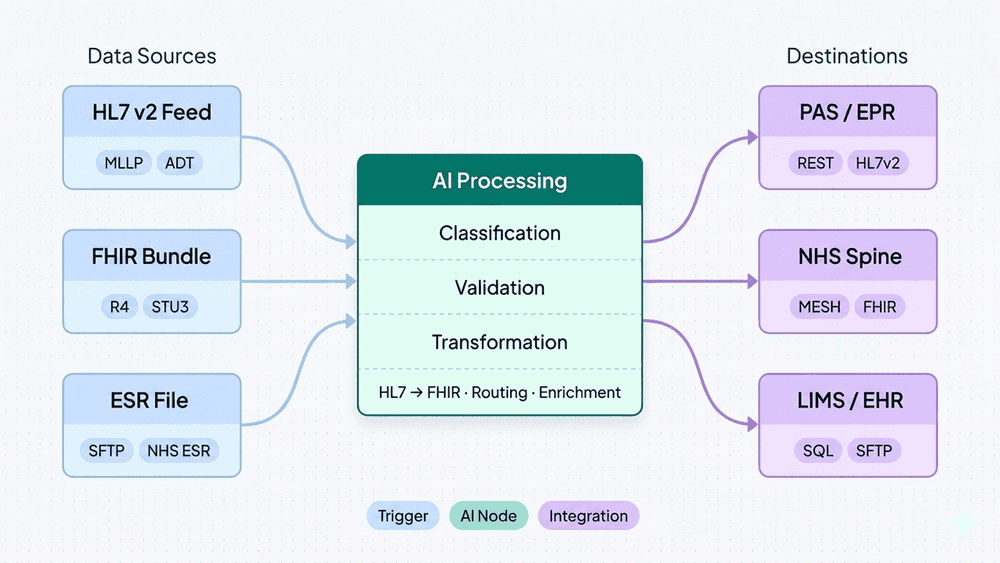
An AI agent embedded in a healthcare workflow needs clean, schema validated data (not raw HL7 strings or malformed JSON). It needs event driven triggers that provide context, not just payloads. It needs a clear separation between the agent's decision scope and the workflow's execution scope, so that the agent recommends or classifies but the workflow engine executes. And it needs comprehensive logging of every decision the agent makes, at a level of detail that satisfies audit requirements.
If your integration platform cannot provide these foundations, bolting an AI agent onto it will create more problems than it solves. The intelligence of the agent is only as good as the data pipeline feeding it.
A practical framework for evaluating AI agents in healthcare
For NHS IT leads assessing AI agent capabilities, whether from a vendor or an internal build, here is a framework that cuts through the noise.
Start with the task, not the technology. Identify the specific workflow step where human effort is highest, error rates are worst, or turnaround time is unacceptable. If an AI agent can measurably improve that step, it is worth evaluating. If the use case starts with "we should use AI" rather than "we need to fix this bottleneck," stop.
Demand explainability. Any AI component in a healthcare workflow must be able to explain its decisions in terms a non technical stakeholder can understand. If the vendor cannot demonstrate this, the product is not ready for NHS deployment.
Insist on a human in the loop. For any AI agent operating in a clinical or patient facing context, require a human review step before the agent's decision becomes final. Autonomy is a spectrum, and healthcare should sit firmly at the supervised end for now.
Test with real data, not demos. AI agents that perform beautifully on curated demo data and collapse on messy, real world ESR files or malformed HL7 feeds are not production ready. Insist on piloting with your actual data flows.
The decision you are actually making
The question is not whether AI agents in healthcare are hype or real. Some of it is hype. Some of it is genuinely useful. The real decision is whether your organisation has the integration maturity, governance clarity, and operational discipline to deploy AI components responsibly.
AI agents are not a shortcut past broken integrations, inconsistent data quality, or undocumented workflows. They amplify whatever is already there. If your data pipelines are clean, your schemas are validated, and your workflow logic is well structured, AI agents can add meaningful value. If those foundations are shaky, AI will not fix them. It will just fail faster and in less predictable ways.
The practical next step is not to buy an AI agent. It is to audit your current workflow architecture: data quality, schema consistency, logging depth, and governance documentation. Get those right first. The AI layer becomes dramatically easier to adopt once the plumbing is sound.
If you are evaluating how AI components could fit into your Trust's integration architecture, WeHub's team works with NHS organisations on exactly this kind of assessment.