
What NHS ESR Starters, Movers, and Leavers Actually Means
It's 8:15 on a Tuesday morning. The Digital team lead opens their inbox to fourteen new starter access tickets from Monday's intake, two of which are junior doctors who were meant to start clinical duties at 7 AM. A consultant who transferred from Neurology to Critical Care three weeks ago still shows up in the Neuro on-call rota. And an access request from a nurse who left the Trust at the end of March has somehow generated a password reset approval overnight.
This is Starters, Movers, and Leavers in practice. Not a policy document. Not a diagram in a Digital Strategy deck. A queue of tickets that shouldn't exist, a compliance risk nobody owns, and a cost line nobody calculates.
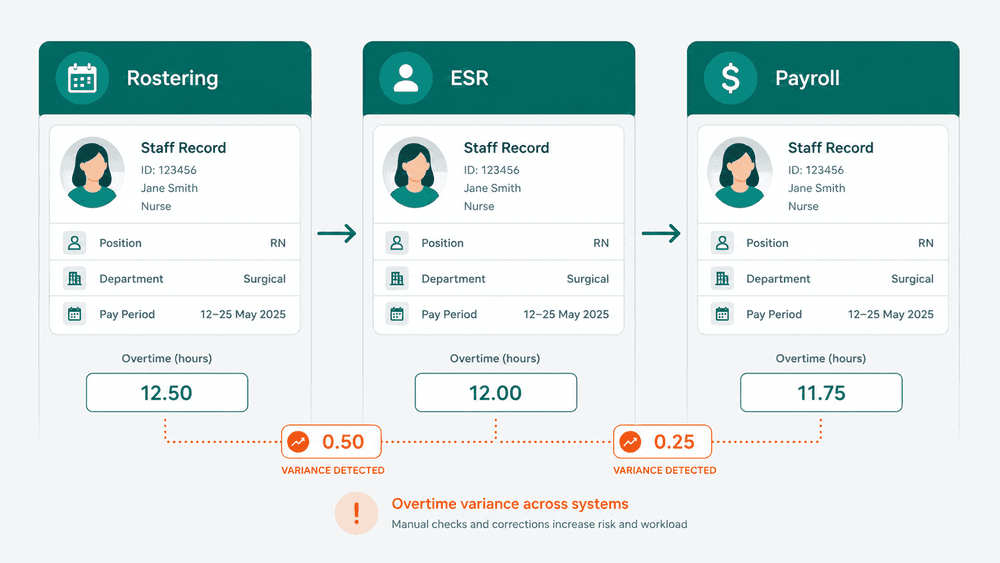
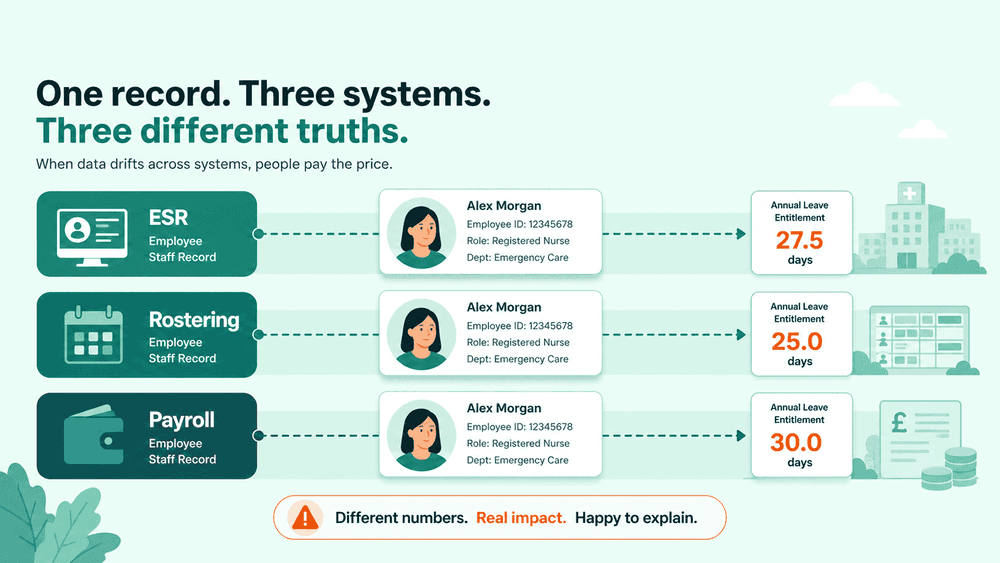
ESR knows exactly when each of those people joined, moved, or left. The problem is that nothing else in the Trust reliably acts on what ESR knows.
"SML" sounds like a human resources category. In a modern Trust it's a workforce lifecycle integration problem that touches Digital, IG, clinical operations, and finance all at once.
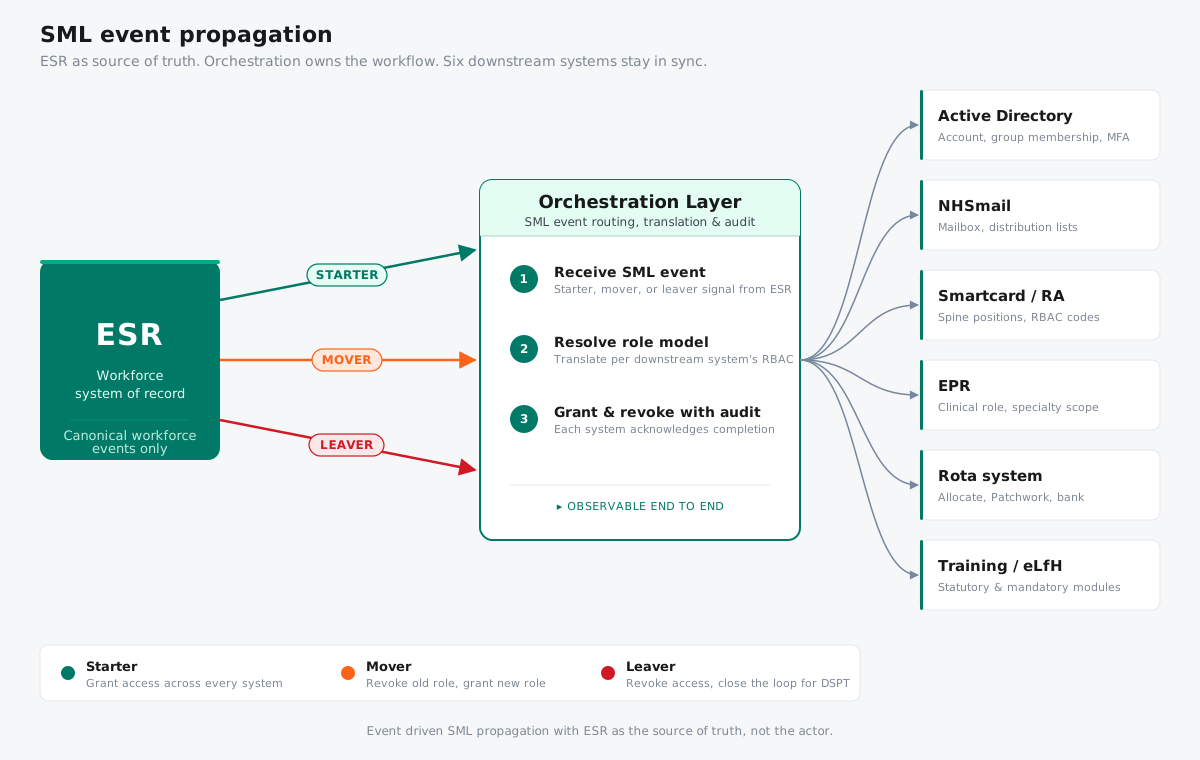
A starter isn't really provisioned until they have an ESR record, an Active Directory account, an NHSmail mailbox, a smartcard with the right RBAC roles, an entry in the EPR, access to the rota system, and completed statutory and mandatory training. That's six or seven systems that each need to know the same thing: someone new has joined, here's their assignment, here's their role.
A mover is the hardest case because it isn't really a single event. It's a termination on one assignment and a new assignment on the same employee record, or an assignment change on the existing one. Either way, the person is the same but their role, and therefore their access, should be different on day one of the new job.
A leaver is the most dangerous case because the cost of getting it wrong isn't an unhappy new hire. It's an active account belonging to someone who no longer works for the Trust.
Why Starters Are Late Even When HR Is On Time
HR is rarely the blocker. The ESR record usually gets created in time. The problem is the sequence of events that has to fire after that record exists.
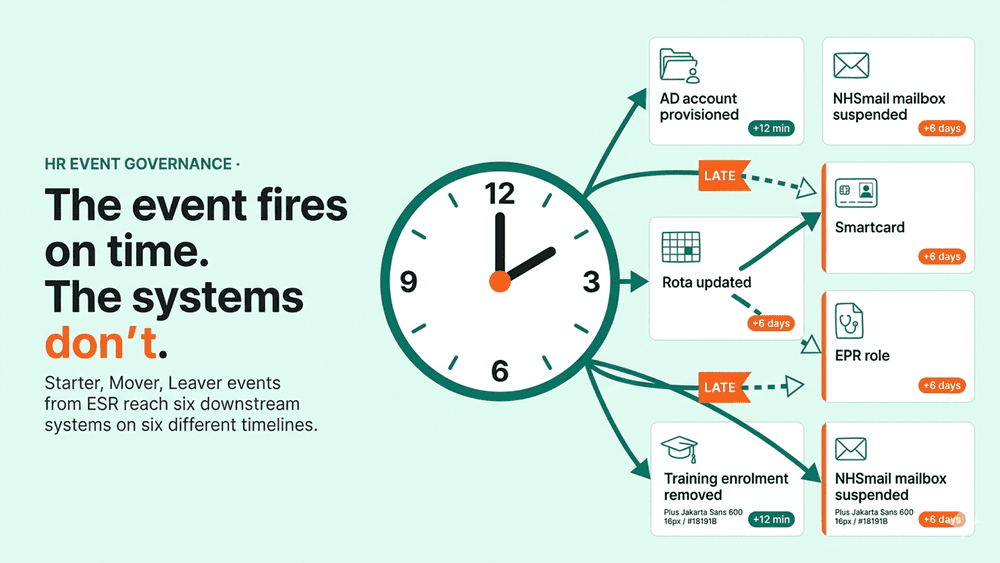
The NHS staff onboarding process has more moving parts than most organisations outside healthcare have to handle, and most Trusts still rely on ESR BI reports delivered by SFTP on a nightly schedule to trigger downstream provisioning. An employee whose record is created at 2 PM on Friday will not appear in the nightly extract until Friday night, won't land in the AD provisioning tool until Monday morning, and won't have a functional NHSmail account until Monday afternoon at the earliest. If they're scheduled to start clinical work Monday at 7 AM, the gap is already obvious.
Smartcards make it worse. A smartcard can only be issued after the ESR record exists, the RA check has been booked, and the person has physically attended. The RA function is chronically understaffed at most Trusts. An expensive locum spending their first morning doing mandatory training on a borrowed laptop isn't a rare edge case. It's Tuesday.
The hidden cost is not just a bad onboarding experience. It is hours of senior clinician time lost every week across hundreds of annual starters, and a pattern of Digital teams being treated as the team that "held up" a clinical hire when the integration layer was the real problem.
Movers: The Quiet Security Risk Nobody Tracks
Movers are the phase of the NHS employee lifecycle that gets the least attention, and they cause some of the most awkward audit findings.
ESR doesn't emit a clean "this person moved" event. Internally, a mover is usually an assignment change, sometimes handled as a termination on the old position and a start on the new one. Downstream systems interpreting a BI extract often see only half the signal. The new access gets provisioned. The old access doesn't get revoked.
A consultant who moves from Neurology to Critical Care shouldn't retain prescribing rights on Neuro ward stock, shouldn't be in the Neuro on-call rota, and shouldn't have EPR access scoped to Neurology patients. In practice, weeks later, they often do. The permissions follow the person by accident rather than following the role by design.
Nobody notices until a CQC visit, a DSPT audit, or an incident where an old account is used in a place it shouldn't have been. By then the mover event is months old and the audit trail is ambiguous.
Leavers: A Compliance Problem Hiding as an HR Problem
Leavers are where workforce lifecycle management stops being an efficiency conversation and starts being a regulatory one.
The DSPT expects Trusts to evidence timely access revocation for leavers. GDPR expects the same for data access rights. In theory, ESR termination triggers AD disable, NHSmail deprovisioning, smartcard revocation, rota removal, and EPR account deactivation. In reality, most Trusts can reliably automate only one or two of those steps. The others run on email, ticket queues, and the memory of whoever spotted the leaver notice first.
The test is easy to run. Pull every ESR termination from the last ninety days. Cross reference against active AD accounts, active NHSmail mailboxes, and active EPR users. The delta is the evidence an auditor is going to ask for, and the delta is almost always bigger than the Digital team expects.
Bank and locum staff make this harder. They leave and re-join constantly, sometimes across multiple Trusts in the same week. Inter Authority Transfers compound the problem further when smartcard roles and Spine positions need to follow the person across organisations cleanly rather than stacking up as orphaned entitlements.
Why ESR Alone Cannot Solve This
ESR is the system of record for workforce. It was never designed to be the provisioning engine for every downstream clinical and operational system in a Trust.
It doesn't know the role model of your EPR. It doesn't know how your rota system maps grades to shift types. It doesn't know that your pharmacy system has its own access list. It doesn't hold the logic for smartcard RBAC codes against clinical specialties. Expecting ESR to orchestrate provisioning across all of that is asking a workforce database to become an identity platform, and it isn't one.
The missing layer in most Trusts isn't a better HR system or a better identity tool. It's the orchestration between the two. The part that listens for SML events, translates them into the specific actions each downstream system needs, and can prove it happened.
What a Working SML Architecture Actually Looks Like
A workforce lifecycle architecture that survives contact with reality tends to share six properties.
- ESR is the source of truth for the event, not the actor. The provisioning logic does not live inside ESR. It lives in an orchestration layer that reads ESR and fans out to everything downstream. ESR remains the canonical record; the orchestration layer owns the workflow.
- SML events are first class, not inferred from file diffs. Nightly BI extracts compared to yesterday's extracts are not an event model. They're an approximation that loses detail and timing. A proper SML pipeline treats each starter, mover, and leaver as its own event with its own payload and its own audit trail.
- Movers are distinct from leavers plus starters. Conflating them causes the access bleed problem. A mover event should explicitly name the old assignment and the new one so that downstream systems can revoke and grant in the right order.
- The revoke path is as reliable as the grant path. Most Trusts have invested far more engineering effort in getting access switched on than getting it switched off. Every grant should have a matching revoke workflow, and both should be observable and evidenceable.
- Delay aware logic handles the dependencies. Smartcards can't be issued before ESR records exist. RA appointments can't be booked before a smartcard is requested. EPR role mapping can't run before the employee has a registered assignment. A working architecture respects these ordering constraints rather than fighting them.
- Every event is observable end to end. If a starter ticket lands on Monday, the Digital lead should be able to see in one dashboard whether their AD, NHSmail, smartcard, EPR, rota, and training entitlements have all completed, and where the failures are.
Where to Start This Week
The instinct is to scope a two year programme to replace the nightly BI extract. That's the wrong first move.
The right first move is an honest audit. Pull a ninety day leaver list from ESR. Compare it against your active account lists in AD, NHSmail, your EPR, and your rota system. Count the gaps. That number is your current SML baseline and it's the one figure that makes the business case for everything that comes next. If it's zero, you're ahead of most Trusts. If it isn't, you now know what the DSPT auditor is going to find before they do.
From there, start small. Pick one downstream system where the grant and revoke flow is the most painful, and design an event driven SML pipeline for just that system. Prove the pattern. Extend it. The Trusts that get NHS workforce lifecycle management right don't do it with a big bang programme. They do it one integration at a time, with ESR as the source of truth and a clear orchestration layer sitting between ESR and everything else.
If you're mapping out how ESR starters, movers and leavers flows should work across your Trust, WeHub's integration team is worth a conversation.