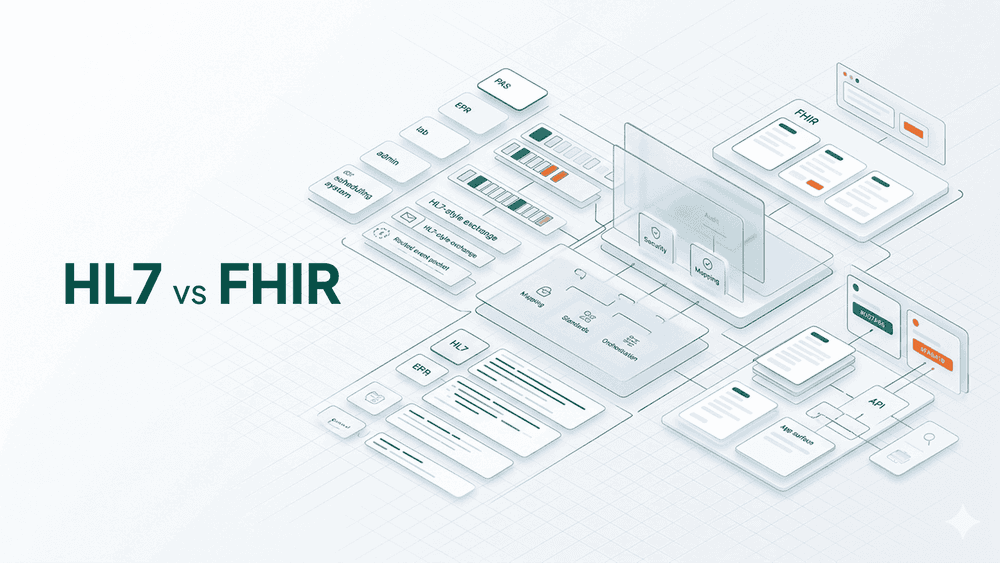
FHIR is the most important standard in modern healthcare integration and one of the most misunderstood. Here's what it actually is and why it matters for what you're building.
Before FHIR: Why Data Exchange Was Painful
If you've ever tried to integrate two clinical systems, you know the moment. You ask what format the data comes in. The answer is HL7 v2. You ask for the message spec. You get a 200-page document and a note that "our implementation varies slightly from the standard."
This is the world that FHIR was designed to fix. Not by replacing everything that came before it, but by giving healthcare a modern, web-native way to exchange structured clinical data — one that developers could actually work with.
What FHIR Actually Is
FHIR stands for Fast Healthcare Interoperability Resources. It's a standard developed by HL7 International, the same organisation responsible for the older HL7 v2 and v3 messaging standards.
Where HL7 v2 was built around pipe-delimited messages designed for point-to-point system communication, FHIR is built around REST APIs, JSON (or XML), and a modular resource model. It's designed to work the way modern software works — over HTTPS, with standard HTTP verbs, returning data formats that any developer can parse without a specialist parser.
The current version in active NHS use is FHIR R4, published in 2019. It's the version mandated for new integration work across NHS England.
How FHIR Resources Work
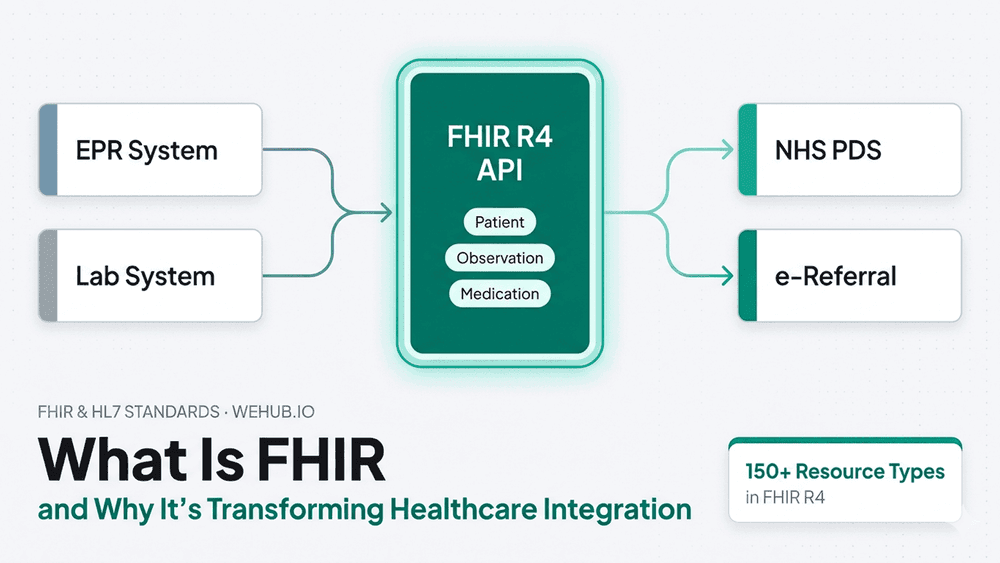
The core concept in FHIR is the resource. A resource is a defined, structured unit of health information Patient, Observation, Medication, Appointment, Condition, Practitioner, and so on. There are over 150 defined resource types in FHIR R4.
Each resource has a defined set of fields, data types, and cardinality rules. When a system exposes a FHIR API, it's exposing endpoints that let you read, create, update, or search those resources using standard HTTP requests.
For example, to retrieve a patient's record, you'd make a GET request to /Patient/{id} and receive a JSON object with the patient's demographics in a predictable, documented structure. No proprietary format. No custom parser. No spreadsheet mapping document.
This predictability is what makes FHIR genuinely useful for integration.
FHIR vs HL7 v2: Why Both Still Exist
The honest answer is: legacy.
HL7 v2 messages have been the backbone of clinical system communication since the late 1980s. They're embedded in EPRs, laboratory systems, pathology platforms, and radiology systems across every major healthcare organisation in the UK and US. They work. They're not going away.
FHIR was designed to complement, not immediately replace, HL7 v2. Most real-world NHS integration environments contain both. A hospital might receive lab results via HL7 v2 feeds, expose patient demographics via a FHIR PDS API, and send referrals through a FHIR-compliant e-Referral Service endpoint.
Your integration layer needs to handle both. The ability to transform between HL7 v2 and FHIR — mapping messages to resources and back — is one of the core capabilities any serious integration platform needs to demonstrate.
Why FHIR Matters for NHS Integration
The NHS has made a deliberate, documented commitment to FHIR as the standard for new integration work. NHS England's API catalogue publishes FHIR-compliant endpoints for core national services: PDS (Patient Demographics Service), NRL (National Record Locator), e-RS, EPS, and others.
For digital health teams building products for NHS markets, this has a direct implication: if your product needs to access national NHS services, it will need to speak FHIR R4. There is no longer a workaround for this through most procurement and integration pathways.
Beyond NHS England, FHIR is also the default in NHS Scotland, NHS Wales, and is the direction of travel for most integrated care system (ICS) infrastructure.
What FHIR Doesn't Solve
FHIR is a standard, not a solution. It's important to be clear about what it doesn't do on its own.
It doesn't solve semantic interoperability. Two systems can both be FHIR-compliant and still disagree on how a clinical concept is coded. If one system uses SNOMED CT codes for diagnoses and another uses free text, FHIR won't bridge that gap automatically.
It doesn't solve information governance. A FHIR API is technically capable of sharing data. Whether that data should be shared, under what conditions, with what consent, and with which organisations is a governance question that FHIR doesn't answer.
And it doesn't guarantee interoperability between compliant systems. FHIR allows a lot of flexibility through its profiling mechanism. Two systems that both claim FHIR R4 compliance can still have implementations that don't directly interoperate without a translation layer.
The Bottom Line
FHIR is the most important standard in modern healthcare integration, and understanding it properly — what it does, what it doesn't do, and where it sits in the broader integration stack — is a practical requirement for any digital health team in 2026.
If you're building on it for the first time, start with the NHS FHIR implementation guides for the specific services you need to integrate with. They document the profiles, extensions, and constraints that matter for NHS compliance. Generic FHIR R4 knowledge is useful. NHS-specific FHIR implementation knowledge is what you actually need.